
www.industry-asia-pacific.com
10
'26
Written on Modified on
BASF Introduces Reduced-Carbon Intermediates for Industrial Value Chains
New BDO, THF, PolyTHF and NMP variants produced in Ludwigshafen reduce product carbon footprint by at least 10 per cent without requiring process or formulation changes.
www.basf.com
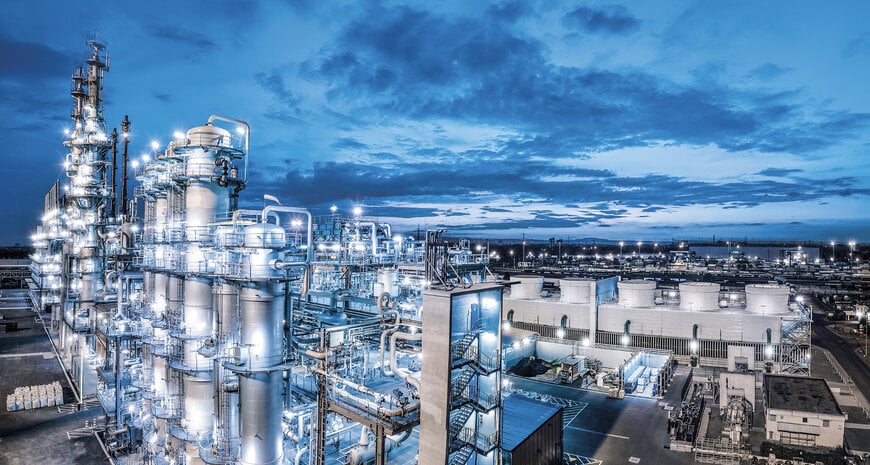
Automotive manufacturing, pharmaceuticals, electronics production, and textile processing increasingly require raw materials with lower lifecycle emissions while maintaining consistent performance in established industrial processes. BASF has introduced new variants of its intermediates butanediol (BDO), tetrahydrofuran (THF), polytetrahydrofuran (PolyTHF®), and N-methylpyrrolidone (NMP) with a reduced product carbon footprint (rPCF), produced at its Verbund site in Ludwigshafen, Germany.
The new product variants achieve a minimum reduction of 10 percent in product carbon footprint compared to the corresponding standard BASF products manufactured at the same site. The reduction is achieved through the use of low-emission feedstocks and utilities in the production process while maintaining identical chemical properties and application performance.
Reduced Carbon Footprint Through Low-Emission Production Inputs
The reduced product carbon footprint (rPCF)¹ of the new intermediates results from adjustments to the upstream production inputs used at the Ludwigshafen Verbund site. By using lower-emission feedstocks and energy sources, BASF can decrease lifecycle emissions associated with the products while maintaining the same specifications and performance characteristics as the conventional materials.
The rPCF variants provide at least a 10 percent reduction in product carbon footprint² compared with the corresponding standard intermediates produced in Ludwigshafen. Because the chemical composition and technical specifications remain unchanged, customers can integrate the materials into existing manufacturing processes without modifying formulations, equipment, or production parameters.
Supporting Scope 3 Emissions Reduction in Industrial Supply Chains
Many industrial manufacturers are working to reduce Scope 3 greenhouse-gas emissions, which originate from upstream materials and supply chains. By offering intermediates with lower embedded carbon, BASF enables customers to reduce emissions associated with their purchased raw materials.
Industries such as automotive manufacturing, pharmaceutical production, electronics manufacturing, textiles, and consumer goods can use these intermediates to lower the carbon footprint of finished products while maintaining established process conditions.
According to BASF, the rPCF variants provide a measurable emissions reduction while maintaining the same product performance and supply reliability as the company’s standard intermediates.
Key Chemical Building Blocks in Multiple Industrial Applications
Butanediol (BDO) serves as a fundamental intermediate for several downstream chemicals. It is used in the production of PolyTHF, as well as in the manufacturing of THF and gamma-butyrolactone (GBL) for pharmaceutical applications. BDO is also a starting material for N-methylpyrrolidone (NMP) and polybutylene terephthalate (PBT) engineering plastics.
PolyTHF is primarily used in the production of elastic fibers such as spandex and elastane, which are commonly found in textiles including sportswear, swimwear, underwear, and stretch fabrics. It also functions as a chemical building block for thermoplastic polyurethanes (TPU) used in abrasion-resistant hoses, films, and cable sheathing, particularly in automotive applications.
Additional applications include polyetheresters, polyetheramides, and cast elastomers, such as wheels used in skateboards and inline skates.
N-methylpyrrolidone (NMP) is a highly polar aprotic solvent used across several industries. It plays a role in pharmaceutical production, filtration membrane manufacturing, lithium-ion battery processing, coatings, inks, resins, agricultural formulations, and certain oil and gas extraction processes.
Production Capacity and Global Supply
BASF produces BDO and its derivatives at large industrial scale, with two production plants and a total annual capacity of approximately 350,000 metric tons. The company also operates three PolyTHF production plants in Europe, North America, and Asia-Pacific, with a combined capacity of 250,000 metric tons per year.
The new rPCF variants produced at the Ludwigshafen Verbund site can be supplied to customers worldwide and form part of BASF’s broader effort to expand its portfolio of materials with reduced product carbon footprints.
Sources
1 The PCF calculation of the rPCF versions of BDO, THF, PolyTHF and NMP produced at the Ludwigshafen Verbund was conducted in accordance with ISO 14067:2018 and the Together for Sustainability - The Product Carbon Footprint Guideline for the Chemical Industry, version 3.0 - December 2024, version 3.0 - December 2024. The PCF calculation is currently undergoing third-party certification by TÜV Rheinland.
2 BASF’s Intermediates division’s rPCF products come with a reduction in PCF of at least 10 percent compared to the BASF standard product in the producing region. The PCF reduction is achieved through active measures, specifically the use of low emission feedstocks and low emission utilities. The calculation does not include downstream value chain emissions such as transportation emissions from factory gate to customer, emissions from further processing and end-of-life emissions.
www.basf.com
Edited by Industrial Journalist, Natania Lyngdoh.
Powered by AI.
