
www.industry-asia-pacific.com
03
'26
Written on Modified on
Transforming tea processing with smart motor solutions
ABB in India has supplied low voltage motors and drive systems to three Assam tea estates to optimize processing workflows.
global.abb
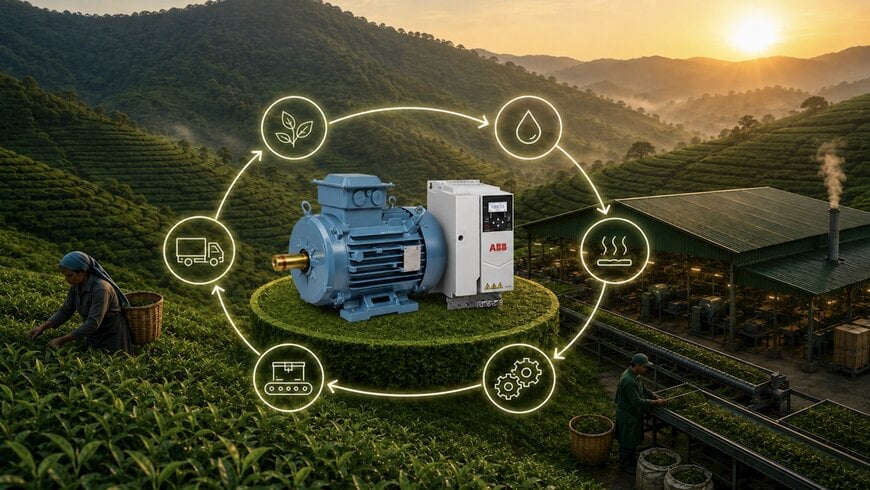
Brewing efficiency in India’s tea heartland is no longer just about tradition; it is increasingly about precision engineering empowering the thousands of medium and large tea processors that form the backbone of one of the country’s most iconic agricultural industries. In the lush, rain-fed plains of Assam, particularly around Tinsukia, one of the largest tea-producing regions in the world, tea estates stretch across undulating landscapes shaped by the Brahmaputra’s fertile basin. Here, where over half of India’s tea is produced, the journey from leaf to cup is both an art and a race against time.
Unlike heavy industrial environments such as metals or cement, tea processing operates at the intersection of agriculture and industry, where biological variability meets mechanical precision. This makes reliability not just a performance metric, but a determinant of quality, flavor, and ultimately, market reputation.
Transitioning from reactive to proactive efficiency
At estates operated by Deodarshan Tea Company Pvt. Ltd, Monkhooli Tea Company, and Inthem Tea Company, this balance has been redefined through their partnership with ABB in India. Tea processing is deceptively complex: within hours of plucking, fresh green leaves must pass through withering, rolling (CTC - Crush, Tear, Curl), oxidation, and drying. Each stage is highly sensitive with minute fluctuations in airflow, motor speed, or temperature can alter the chemical composition that defines aroma, strength, and color. Unlike conventional industrial processes that can tolerate minor deviations, tea manufacturing leaves little room for error. The perishability of raw leaves means that any equipment downtime or inconsistency directly translates into loss of both product and value.
Operating for nearly 200 days a year with peak production cycles stretching up to 16 hours a day, these estates face intense operational demands. Historically, aging motors and unreliable starters posed a constant risk to continuity. As Sumit Agarwal, owner of the 3 tea companies notes, the transition to ABB’s advanced LV motors and drive systems marked a critical shift from reactive maintenance to proactive efficiency. The transition to ABB’s advanced LV motors and drive systems marked a critical shift from reactive maintenance to proactive efficiency. These solutions brought in not just robustness, but a level of precision control that aligns seamlessly with the nuanced requirements of tea processing ensuring steady airflow in withering troughs, consistent torque in rolling machines, and controlled heat in dryers.
The impact has been both immediate and measurable. Factories reported a marked improvement in operational consistency, eliminating disruptions that previously compromised batch quality. Energy consumption a significant cost factor in tea processing was substantially reduced, reinforcing the business case for modernization in a sector often perceived as traditional. More importantly, consistent processing translated into uniform product quality, strengthening brand equity in both domestic and export markets, where Indian tea continues to hold a premium position.
Unlocking value in heritage industries
What makes this transformation particularly significant is how it redefines the role of technology in agro-based industries. While large industrial sectors have long embraced automation and energy efficiency, MSME-led sectors like tea processing deeply rooted in legacy practices are now unlocking similar value through targeted, practical technology investments that improve productivity without compromising tradition. This is not about replacing heritage, but about enabling it to thrive in a modern, competitive landscape where sustainability, cost efficiency, and quality must coexist.
In many ways, the modernization of these Assam-based tea estates offers a compelling blueprint. It demonstrates that world-class efficiency is not exclusive to heavy industry. It is equally transformative for MSMEs in sectors where the end product is as sensory and delicate as tea, helping them strengthen quality, improve competitiveness, and build resilient businesses for the future. By embedding reliability and precision at the core of processing, ABB and its partners are not just improving operations; they are safeguarding the integrity of every cup brewed, while shaping a more sustainable and competitive future for India’s tea economy.
Additional Context
This section details technical specifications not included in the original news release.
Variable Frequency Drives (VFDs) control the rotational speed and torque of AC induction motors by modulating the frequency and voltage of the supplied electrical power. In tea processing facilities, standard three-phase low voltage squirrel-cage induction motors are paired with VFDs to match motor output directly to fluid dynamic and mechanical load requirements.
In withering troughs, centrifugal and axial fans driven by VFD-controlled motors modulate volumetric airflow rates and static pressure, removing moisture uniformly from green leaves without causing thermal damage to delicate plant tissues. During the rolling stage, Crush, Tear, Curl (CTC) machines utilize counter-rotating cylindrical helical rollers operating at differential speed ratios (typically 1:10) to cut and shred leaf structures. VFD vector control maintains precise differential speed synchronization and torque compensation as leaf density fluctuates entering the rollers.
In continuous fluid bed dryers, VFDs control blower speeds and feed conveyor rates to regulate thermal air velocity and residence time, maintaining precise temperature gradients necessary to halt enzymatic oxidation and achieve target final moisture content without scorching the tea.
Edited by Romila DSilva, Induportals Editor, with AI assistance.
www.abb.com
