
ASRock Industrial Unveils Robotics-in-a-Box to Democratize Physical AI Development
Powered by the Intel Core Ultra X7 Processor 358H, the turnkey development kit integrates edge computing, an RGB-D camera, 6-DOF leader-follower robotic arms, and AiRoboStarter software.
www.asrockind.com
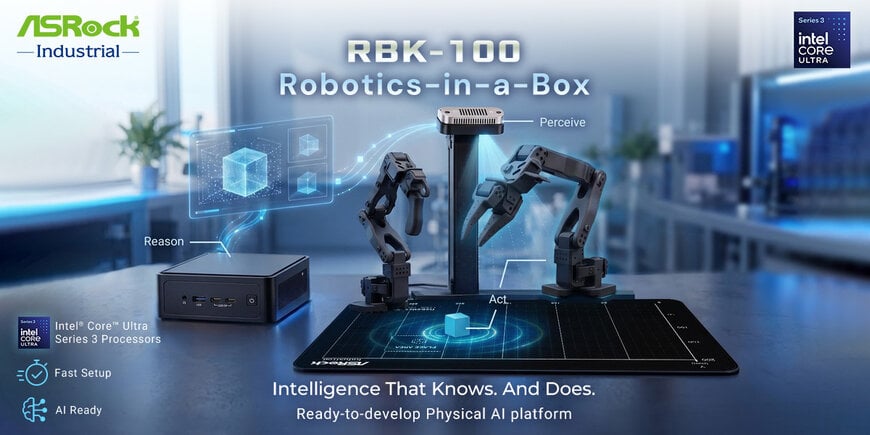
ASRock Industrial has announced the launch of RBK-100 Robotics-in-a-Box, an integrated Physical AI development platform built around the ASRock Industrial NUC BOX-358H powered by the Intel Core Ultra X7 Processor 358H. Designed to simplify robotic AI development for researchers, educators, and developers, the turnkey system combines local AI computing, an RGB depth camera, a 6-DOF leader-and-follower robotic arm set, and pre-installed AiRoboStarter software to reduce system integration complexity and let users focus on AI model experimentation and robotic skill development.
Hardware specifications and AI software workflows
The RBK-100 platform unifies edge compute, machine vision, and physical manipulation within a single pre-configured environment:
- AI-ready edge computing: Driven by the Intel Core Ultra X7 Processor 358H inside the NUC BOX-358H, the system ships with 32GB DDR5 memory in the standard configuration or 64GB DDR5 memory in the Advanced configuration, paired with a 512GB PCIe Gen4 SSD.
- Integrated robotic vision and manipulation: An integrated RGB-D camera captures colour and depth data for spatial perception and object interaction. Paired with a 6-DOF leader-and-follower robotic arm set, the system allows developers to record demonstrations and explore AI-based pick-and-place, object handling, and learned robotic skills.
- Physical AI development with AiRoboStarter: The standard 32GB configuration includes pre-installed AiRoboStarter software covering demonstration recording, dataset review, model training, and skill execution, supporting model workflows such as ACT and Pi0.5, with SmolVLA support planned for a future release.
- Optional agentic AI with AiRoboStarter Advanced: Available on the 64GB configuration, AiRoboStarter Advanced adds an agentic AI workflow linking voice interaction, reasoning, visual perception, and trained robotic skills—incorporating speech-to-text (STT), text-to-speech (TTS), large language models (LLMs), vision, object detection, web search, custom APIs, and robot skill integration, with supported models, features, and performance depending on the software release and validated configuration.
Industry perspectives on scaling Physical AI
James Lee, Chairman of ASRock Industrial, stated that Physical AI marks a major step in bringing intelligence into the physical world, noting that Robotics-in-a-Box—developed in collaboration with Intel—simplifies the path from initial AI experimentation to real-world robotic applications for researchers, educators, and developers.
John Healy, Vice President and General Manager of the Industrial and Robotics Division at Intel, added that scaling Physical AI requires an open technology foundation that makes complex robotic systems easier to develop and deploy, enabling teams to turn robotics concepts into practical applications using Intel Core Ultra processors.
Advancing manipulation research and multimodal execution
Engineered for robotic manipulation research, academic instruction, and Physical AI prototyping, RBK-100 provides an end-to-end environment to collect demonstration data, train models, and validate learned robotic behaviours. By consolidating edge compute, robotic hardware, and AI development software into one system, the platform streamlines setup across the entire Physical AI lifecycle from data capture to physical execution.
Additional Context:
This section explains general principles of leader-follower imitation learning and Vision-Language-Action (VLA) models in robotics not included in the original press release.
In modern robotic manipulation research, teleoperated leader-follower architectures replace complex inverse-kinematics coding with imitation learning. A human operator physically guides a lightweight "leader" arm through a task—such as grasping or sorting irregular objects—while joint encoders record angular trajectories and synchronize them with live RGB-D visual streams. A "follower" arm mirrors these movements in real time, generating high-fidelity multimodal datasets used to train neural policies like Action Chunking with Transformers (ACT).
Vision-Language-Action (VLA) architectures extend this capability by pairing visual perception and natural language prompts directly with low-level motor control outputs. Running these models locally on edge AI processors equipped with integrated Neural Processing Units (NPUs) and GPUs avoids cloud round-trip latency, ensuring deterministic control loops during physical contact tasks while keeping proprietary training datasets on-premises.
Edited by an industrial journalist, Lekshman Ramdas, with AI assistance.
