
www.industry-asia-pacific.com
14
'26
Written on Modified on
Tungsten Carbide Recycling Via Amino Acid Refining
Kyocera Corporation deploys an amino acid refining facility to recover critical tungsten carbide from used cutting tools under METI supply chain certification.
global.kyocera.com
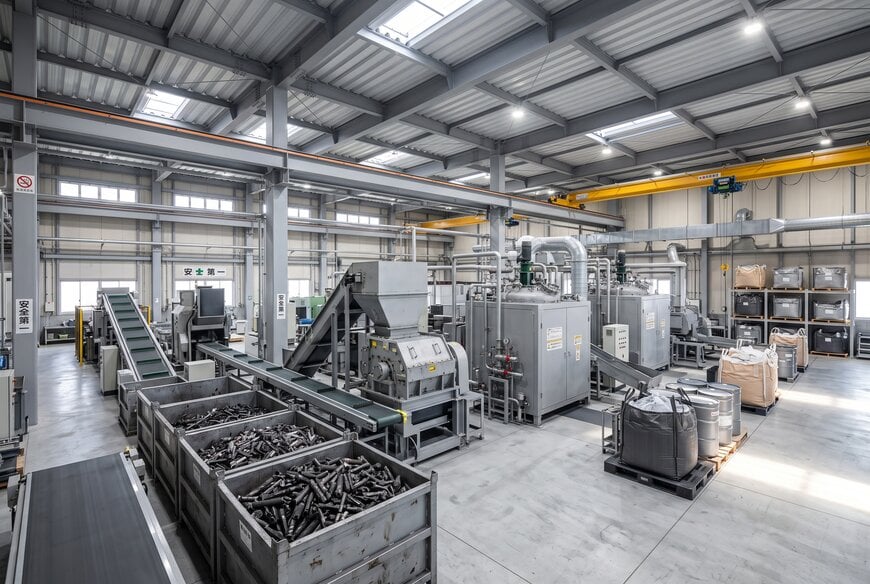
Kyocera Corporation has established an industrial program to recover secondary tungsten carbide from spent cemented carbide tooling using a proprietary chemical extraction process. Certified under the Ministry of Economy, Trade and Industry program for securing critical minerals, the initiative addresses material security across automotive machining, aerospace manufacturing, and semiconductor tooling sectors.
Operational Challenge and Raw Material Dependency
Tungsten serves as the core constituent in cemented carbide tooling, providing the high hardness, thermal resistance, and mechanical wear properties required for metal-cutting operations. Japan remains heavily reliant on primary tungsten imports, exposing industrial precision machining and microelectronics manufacturing to external supply bottlenecks.
Conventional hydrometallurgical recycling systems for cemented carbide often involve multi-stage digestion, high chemical reagent consumption, and intensive energy inputs to separate tungsten from cobalt binders and insoluble carbide fractions. Maintaining raw material continuity requires closed-loop refining methods that integrate directly into existing cutting-tool life cycles without excessive secondary emissions.
Amino Acid-Based Refining Architecture
To bypass standard high-temperature and multi-stage extraction methods, Kyocera developed an amino acid-based streamlined process. The reaction pathway employs naturally derived amino acids as selective chelating and leaching agents, reacting directly with carbide scrap matrices.
By utilizing organic coordination chemistry, the system selectively solubilizes and extracts tungsten carbide while eliminating multiple intermediate precipitation, washing, and re-crystallization steps typical of alkaline leaching. Reducing process stages lowers overall reagent throughput and thermal loads, resulting in higher operational recovery efficiency and a lower net environmental footprint per kilogram of recovered tungsten.
Facility Deployment and Supply Chain Integration
Under METI certification 2026 Critical Minerals No. 5-1, Kyocera is integrating the extraction facility directly into its domestic manufacturing network in Japan. Commercial operations are targeted for fiscal 2030.
The refining plant interfaces with Kyocera’s existing logistics infrastructure, which handles post-service cutting tools collected from industrial machining facilities. The installation functions in series with current regrinding and tool-reconditioning lines, directing heavily worn or fractured inserts that exceed regrinding dimensional tolerances into chemical processing. The reclaimed tungsten carbide feed is subsequently routed back into primary powder metallurgy operations for sintering new tooling grades.
Industrial Process Impact
Establishing on-site tungsten recycling establishes closed-loop material circulation for hard metal cutting applications. By converting machining scrap into refined carbide feedstocks, the installation insulates precision manufacturing from primary mineral volatility, stabilizes input costs, and maintains baseline chemical purity required for standardized cutting inserts.
Edited by Evgeny Churilov, Induportals Media - Adapted by AI.
www.global.kyocera.com
