
www.industry-asia-pacific.com
12
'26
Written on Modified on
Hydrogen Aircraft Engine Combustor Lowers Emissions
Kawasaki Heavy Industries demonstrated stable 100 percent hydrogen propulsion and low nitrogen oxide output using an aircraft engine combustor at JAXA Noshiro.
www.kawasakirobotics.com
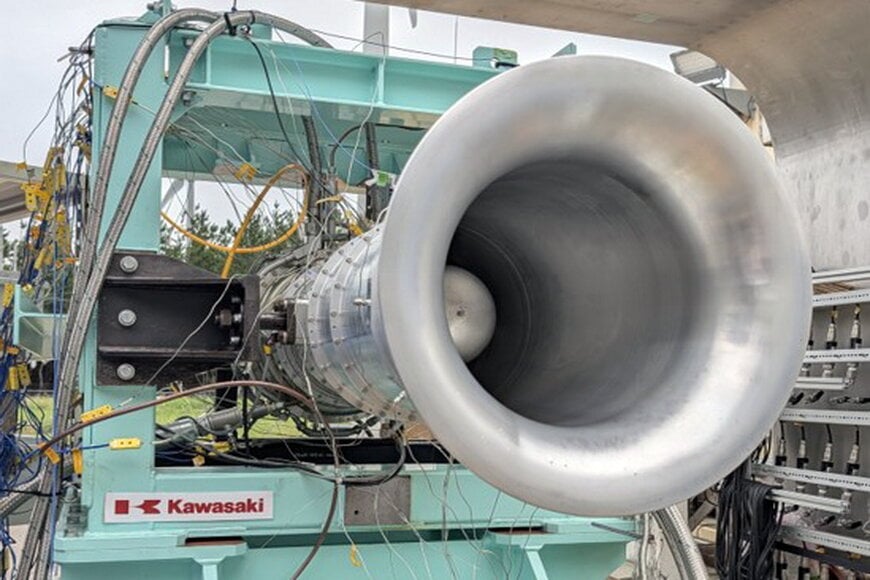
Aviation decarbonization requires eliminating fossil fuel combustion without producing high thermal nitrogen oxide (NOx) levels during peak engine operation. Kawasaki Heavy Industries, Ltd. has completed ground operational testing of a small aircraft engine fitted with a newly engineered hydrogen combustor, advancing propulsion architectures for commercial aviation.
Hydrogen Combustion Dynamics and Thermal NOx Suppression
Burning pure hydrogen eliminates carbon dioxide emissions entirely, but hydrogen features a laminar flame speed roughly an order of magnitude faster than conventional Jet A-1 kerosene and burns at significantly higher adiabatic flame temperatures exceeding 2,200 degrees Celsius. In conventional gas turbine combustion chambers, these localized high-temperature zones accelerate the Zeldovich mechanism, which exponentially increases thermal NOx formation.
To resolve this thermal profile challenge, the newly developed combustor adapts proprietary micromix combustion technology, a method originally engineered and commercialized by Kawasaki for industrial power generation gas turbines. Rather than feeding fuel into a single large flame zone, the micromix architecture divides pure hydrogen fuel into an array of miniature fuel injection points that interact with localized cross-flow air jets.
This design distributes the reaction zone across numerous micro-flames. By drastically reducing both the physical volume of individual flame zones and the residence time of combustion gases at peak temperatures, the system suppresses localized hot spots. The resulting combustion pattern provides stable flame anchoring without risk of flashback, yielding low NOx concentration while burning 100 percent hydrogen.
Verification Profile and System Integration
The operational evaluation was conducted at the Japan Aerospace Exploration Agency (JAXA) Noshiro Rocket Testing Center in Akita Prefecture. Testing confirmed combustion stability, mechanical integrity, and thrust generation across every flight-representative operating regime.
Engine verification tracked parameters across a full sequence:
- Ignition sequence and cold start dynamics
- Engine spool-up and transition through idle speeds
- Steady-state operation simulating mid-altitude cruise conditions
- Dynamic transient acceleration and deceleration sweeps
- Controlled fuel shutoff and engine shutdown
Data gathered from the trial verified that the micromix chamber maintains flame stability during abrupt fuel flow rate adjustments while remaining compliant with environmental emissions standards governed by the International Civil Aviation Organization (ICAO).
Development Roadmap and Aviation Applications
The evaluation forms a core milestone within the "Development of Core Technologies for Hydrogen Aircraft" project, selected and subsidized under the "Next-Generation Aircraft Development" program managed by Japan's New Energy and Industrial Technology Development Organization (NEDO) through the Green Innovation Fund.
Covering a development timeframe running from 2021 through 2030, the initiative addresses the integration of propulsion systems with dedicated cryogenic fuel storage. Kawasaki previously validated small-scale hydrogen aircraft engine runs alongside functional testing of liquefied hydrogen (LH2) storage vessels. Future engineering phases will progress toward integrated ground testing to evaluate coupled system performance across the airframe interface, engine cores, fuel delivery manifolds, and insulated fuel tanks.
Additional Context
This section details technical specifications and competitive benchmarking not included in the original product announcement.
Global aerospace manufacturers are actively exploring two parallel pathways for hydrogen propulsion: direct combustion in gas turbines and hydrogen fuel cell electric systems. Direct combustion remains the primary solution for regional, narrowbody, and widebody commercial airliners where power density requirements exceed the practical limits of current megawatt-class electric motors and fuel cell stacks.
Comparable aerospace initiatives include the Airbus ZEROe demonstrator program and the CFM International (GE Aerospace and Safran) hydrogen demonstration project, both working to validate direct hydrogen combustion using modified turbofan architectures. While those programs evaluate lean-premixed and multi-point injection strategies derived from conventional aviation combustors, the adaptation of industrial micromix injectors presents a distinct mechanical approach centered on micro-diffusion burning. Micromix arrays mitigate the narrow flammability margin and high acoustic vibration risks often associated with lean-premix hydrogen flames.
Cryogenic distribution systems must supply liquid hydrogen at minus 253 degrees Celsius, convert the cryogenic liquid into gaseous hydrogen through onboard heat exchangers, and regulate delivery pressures before injection into the combustor nozzles. Regulatory certification frameworks for direct hydrogen aviation engines remain under active definition within the SAE International E-40 Electrified Propulsion committee and the EUROCAE Working Group 122, focusing on fuel system venting, cabin safety zoning, and emissions limits beyond ICAO Annex 16 Volume II requirements.
Edited by Evgeny Churilov, Induportals Media - Adapted by AI.
www.global.kawasaki.com
Development Roadmap and Aviation Applications
The evaluation forms a core milestone within the "Development of Core Technologies for Hydrogen Aircraft" project, selected and subsidized under the "Next-Generation Aircraft Development" program managed by Japan's New Energy and Industrial Technology Development Organization (NEDO) through the Green Innovation Fund.
Covering a development timeframe running from 2021 through 2030, the initiative addresses the integration of propulsion systems with dedicated cryogenic fuel storage. Kawasaki previously validated small-scale hydrogen aircraft engine runs alongside functional testing of liquefied hydrogen (LH2) storage vessels. Future engineering phases will progress toward integrated ground testing to evaluate coupled system performance across the airframe interface, engine cores, fuel delivery manifolds, and insulated fuel tanks.
Additional Context
This section details technical specifications and competitive benchmarking not included in the original product announcement.
Global aerospace manufacturers are actively exploring two parallel pathways for hydrogen propulsion: direct combustion in gas turbines and hydrogen fuel cell electric systems. Direct combustion remains the primary solution for regional, narrowbody, and widebody commercial airliners where power density requirements exceed the practical limits of current megawatt-class electric motors and fuel cell stacks.
Comparable aerospace initiatives include the Airbus ZEROe demonstrator program and the CFM International (GE Aerospace and Safran) hydrogen demonstration project, both working to validate direct hydrogen combustion using modified turbofan architectures. While those programs evaluate lean-premixed and multi-point injection strategies derived from conventional aviation combustors, the adaptation of industrial micromix injectors presents a distinct mechanical approach centered on micro-diffusion burning. Micromix arrays mitigate the narrow flammability margin and high acoustic vibration risks often associated with lean-premix hydrogen flames.
Cryogenic distribution systems must supply liquid hydrogen at minus 253 degrees Celsius, convert the cryogenic liquid into gaseous hydrogen through onboard heat exchangers, and regulate delivery pressures before injection into the combustor nozzles. Regulatory certification frameworks for direct hydrogen aviation engines remain under active definition within the SAE International E-40 Electrified Propulsion committee and the EUROCAE Working Group 122, focusing on fuel system venting, cabin safety zoning, and emissions limits beyond ICAO Annex 16 Volume II requirements.
Edited by Evgeny Churilov, Induportals Media - Adapted by AI.
www.global.kawasaki.com
