
www.industry-asia-pacific.com
02
'26
Written on Modified on
OMRON launches R1 inverter extending drive range to 630 kW
R1 supports demanding motion applications with predictive maintenance, SIL3 PLe safety, multilingual commissioning and compatibility with existing M1 programming environments.
www.onsemi.com
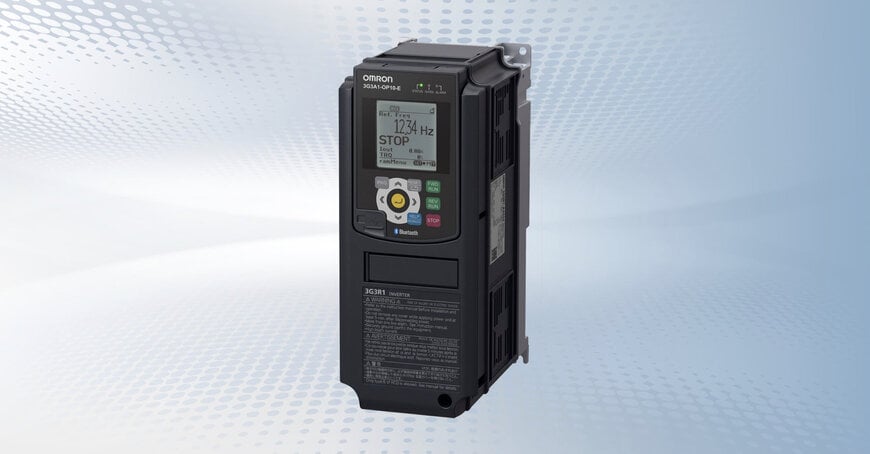
Coordinating dynamic motor control across heavy-duty industrial machinery presents significant mechanical challenges, particularly when managing zero-speed torque on vertical axes and high-inertia loads. OMRON introduced its R1 (3G3R1) variable speed drive, expanding its inverter portfolio to deliver scalable 400 V power control from 0.4 kW to 630 kW across heavy lifting, material forming, and continuous fluid handling applications.
Closed-Loop Vector Dynamics and Zero-Speed Holding Architecture
Industrial machine builders frequently balance contrasting kinematic requirements within a single automation architecture. While continuous horizontal conveyors demand basic velocity regulation, vertical axes—such as hoists, vertical lifts, and stacker cranes—require instant, full-rated torque the millisecond an electromechanical brake disengages to prevent gravitational drop or mechanical backlash.
The R1 variable speed drive resolves this control boundary by integrating high-performance open- and closed-loop vector algorithms engineered to sustain continuous torque down to 0 Hz. This control response stabilizes dynamic loads across hoists, stamping presses, rolling mills, industrial winding machines, and machine tool spindles, while retaining modulation efficiency for centrifugal fans, process pumps, and industrial gas compressors.
Unified Parameter Structure and Migration Engineering
Software migration between drive power classes traditionally imposes heavy integration costs, requiring control redesign and reconfiguration of fieldbus telegrams. To eliminate engineering friction, OMRON aligned the R1 series with the architecture of its established M1 inverter.
The R1 shares an identical internal parameter structure, matching terminal nomenclature, and identical communication addressing with the M1 platform. Control engineers program the unit through the unified Sysmac Studio integrated development environment (IDE) using standard Drive Programming customization. This compatibility permits existing programmable logic controller (PLC) routines, motion profiles, and application-specific function blocks to transfer directly to the R1 without rewriting control software or modifying field wiring schematics.
Predictive Diagnostics and Industrial Reliability Standards
Unscheduled production interruptions in continuous processing lines frequently stem from thermal overstress or mechanical cooling failure. The R1 incorporates hardware-level predictive maintenance diagnostics designed around a 10-year component service life, encompassing internal capacitor banks and active cooling fans.
Internal monitoring circuits track insulated-gate bipolar transistor (IGBT) thermal fatigue, monitor cooling airflow degradation, and record operational trace logs. In the event of an operational anomaly, internal memory registers capture diagnostic traceback data to accelerate root-cause fault analysis. Commissioning and localized parameter adjustments occur through a detachable graphical keypad supporting 10 operating languages, onboard USB, and wireless Bluetooth connectivity for parameter access via mobile devices.
Integrated Machine Safety and Environmental Hardening
To streamline safety-circuit design, the drive integrates Safe Torque Off (STO) functional safety as standard hardware, rated to Safety Integrity Level 3 (SIL 3) in compliance with IEC 61508 and Performance Level e (PL e) under ISO 13849-1. This onboard architecture cuts power directly to the motor gate drivers without requiring secondary external contactors or redundant safety relays.
For operation in corrosive industrial environments, the internal circuit boards feature protective conformal coatings certified to IEC 60721-3-3 Class 3C2 for chemical and gas resistance. Thermal design options include a push-through mounting adapter that isolates heat-sink airflow to an external IP55-rated channel, directing thermal dissipation outside electrical cabinets. Standard serial connectivity relies on Modbus RTU, backed by CE, UL, cUL/CSA, and RoHS2 compliance marks.
Additional Context:
This section details technical specifications and competitive benchmarking not included in the original product announcement.
High-power low-voltage variable speed drives operating in the 400 V three-phase class are benchmarked by their dynamic current response, overload thresholds, and internal harmonic mitigation. In the R1 architecture, closed-loop vector control achieves a current loop response frequency reaching 1500 Hz, with maximum output frequencies up to 590 Hz. The drive framework incorporates multiple duty-rating classifications, including High Heavy Duty (HHD) with overload margins of 150% for 60 seconds and 200% for 3 seconds, Heavy Duty (HD), and Normal Duty (ND) designed for variable-torque centrifugal loads. Up to 75 kW, the units incorporate internal dynamic braking transistors, with built-in braking resistors installed up to 7.5 kW to minimize cabinet footprint.
Within the global industrial automation sector, the OMRON R1 competes alongside established heavy-duty drive families, including the Siemens SINAMICS G120/S120 modular platforms, the ABB ACS880 industrial drive line, and the Yaskawa GA700 series. While ABB and Siemens rely heavily on proprietary industrial Ethernet ecosystems—such as PROFINET and PROFIsafe—the R1 platform leverages standardized Modbus RTU integration alongside OMRON's Sysmac Studio EtherCAT motion architecture. Furthermore, where many general-purpose industrial drives require optional auxiliary safety modules to achieve SIL 3 / PL e STO or separate conformal upgrades to satisfy harsh environmental exposure, the baseline integration of SIL 3 STO and IEC 60721-3-3 Class 3C2 chemical protection positions the R1 as a direct drop-in solution for contaminated manufacturing environments and high-load mechanical processing lines.
Edited by Natania Lyngdoh, Induportals editor, with AI assistance.
www.omron.com
