
www.industry-asia-pacific.com
25
'26
Written on Modified on
Additive Manufacturing Systems Expand Industrial Production in Japan
APPLE TREE introduces SLS and SLA platforms for faster prototyping, precision tooling and low-volume end-use parts.
apple-tree.co.jp
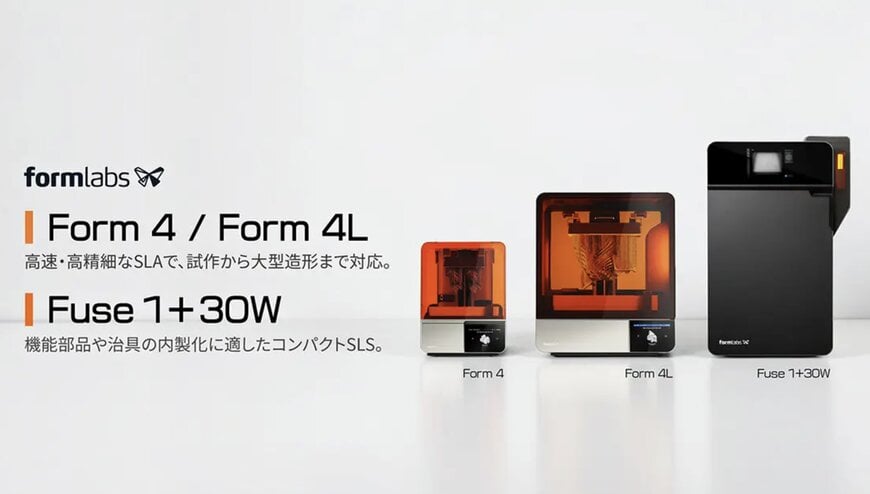
APPLE TREE Co., Ltd. is introducing the Fuse 1+ 30W, Form 4, and Form 4L additive manufacturing systems to the Japanese industrial market. This hardware distribution initiative provides functional prototyping and low-volume, end-use part production capabilities for the automotive, aerospace, and precision engineering sectors.
Transitioning from Prototyping to End-Use Production
The manufacturing industry increasingly requires hardware ecosystems that support high-mix, low-volume production without the extensive lead times associated with traditional injection molding or subtractive tooling. By integrating both Selective Laser Sintering (SLS) and Stereolithography (SLA) technologies into a unified additive manufacturing ecosystem, engineering teams can shift fabrication operations in-house. This operational shift reduces dependency on external suppliers and accelerates the design verification process for complex geometries, yielding measurable cost reductions and improved development efficiency.
Laser Sintering Mechanics and Powder Management
The Fuse 1+ 30W system operates on the Selective Laser Sintering principle, utilizing a 30-watt fiber laser to thermally fuse nylon-based polymer powders into high-strength functional components. A mechanical advantage of the SLS methodology is the complete elimination of dedicated support structures, as the surrounding unsintered powder bed naturally supports the part during the thermal fusion process. This mechanism allows for the efficient manufacturing of complex, interlocking assemblies and internal channels. Furthermore, the system incorporates a closed-loop powder recovery workflow, enabling operators to recycle unused material to lower the cost per part.
High-Resolution Stereolithography and Scalable Workflows
For applications requiring isotropic strength, high surface finish, and strict dimensional tolerances—such as visual inspection models and precision manufacturing jigs—the Form 4 and Form 4L systems utilize advanced stereolithography technology. These units deploy an ultraviolet light engine to selectively cure liquid photoreactive resin layer by layer. The baseline Form 4 is designed for rapid design iterations and small-scale precision parts. For larger physical assemblies, the Form 4L expands the available build volume. This dimensional increase allows operators to print substantially larger single components or improve overall production efficiency by nesting multiple smaller parts within a single print cycle.
Additional Context
This section details technical specifications and competitive benchmarking not included in the original news release.
In the benchtop SLS market, systems like the Fuse 1+ 30W are typically benchmarked against alternatives such as the Sinterit Lisa Pro or Sintratec S2. Benchmarking criteria primarily focus on laser power, thermal control, and powder refresh rates. The integration of a 30W fiber laser enables print speeds up to 12.5 millimeters per hour on the Z-axis, offering a measurable throughput increase over traditional 10W diode-based systems. In the professional stereolithography sector, the Form 4 series competes with high-speed resin platforms like the Nexa3D XiP. Performance in this category is evaluated based on Z-axis layer resolution—often reaching 25 microns—and the optical intensity of the light engine, which dictates resin curing speed. Providing a localized additive architecture allows facilities to bypass traditional supply chain bottlenecks while maintaining industrial-grade polymer manufacturing standards.
Edited by Aishwarya Mambet, Induportals Editor, with AI assistance.
www.apple-tree.com
