
www.industry-asia-pacific.com
26
'26
Written on Modified on
OEM-Certified Compressor Remanufacturing for Industrial Lifecycle Management
Atlas Copco has introduced a factory-controlled remanufacturing framework designed to restore industrial compressor systems to original equipment specifications.
www.atlascopco.com
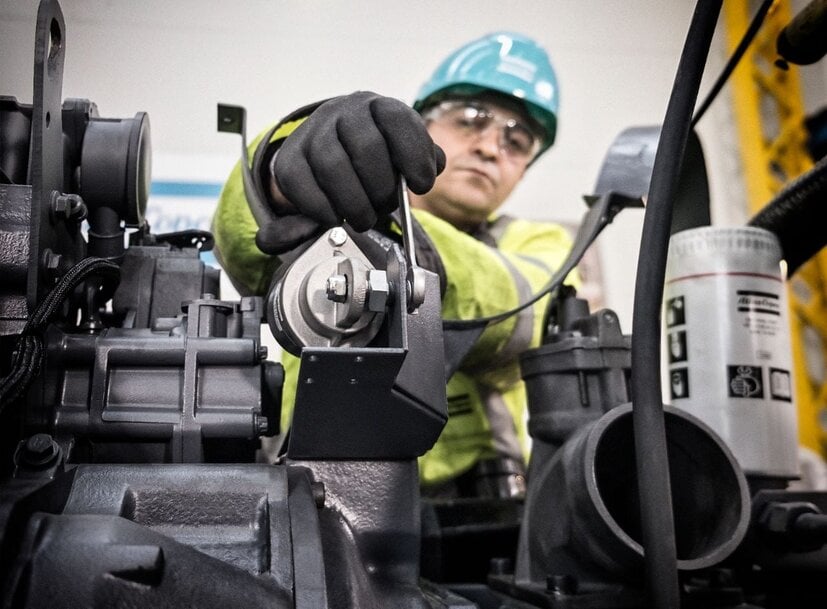
Atlas Copco has integrated the Reman Program within its RePower Centre to provide an OEM-certified remanufacturing solution for industrial compressors. The program is developed to service facilities in the automotive, pharmaceutical, fast-moving consumer goods (FMCG), textile, cement, steel, infrastructure, and general manufacturing sectors. In these environments, continuous airflow generation is a required parameter for operational continuity. The remanufacturing approach allows operators to restore equipment performance metrics to original baselines without procuring entirely new mechanical systems.
Factory-Controlled Restoration Mechanisms
The remanufacturing protocol is based on a structured, factory-controlled process designed to achieve performance parity with newly manufactured equipment. Incoming compressors undergo systematic disassembly and component-level inspection. During the restoration phase, mechanical technicians replace degraded elements with quality-assured components. Critical subsystems, including air ends, drive interfaces, cooling assemblies, and controller modules, are mechanically and electronically recalibrated to match the original OEM engineering specifications.
System Validation and Operational Impact
Following component restoration and complete assembly, each compressor unit is subjected to diagnostic testing. This validation process includes precise airflow measurement, pressure retention checks, mechanical safety assessments, and full-load performance verification prior to deployment. By bringing compressors back to factory engineering standards, the process stabilizes equipment uptime. Extending the functional lifecycle of the existing asset lowers the total cost of ownership, reducing the frequency of emergency maintenance interventions and extending the interval before full-system replacement is required.
Strategic Asset Utilization
Prasanna Kulkarni, General Manager of the Power Technique Customer Center in India for Atlas Copco, indicated that the process addresses the operational necessity of optimizing costs. Kulkarni stated that the initiative enables industrial operators to "maximize the value of existing assets with a certified solution that enhances reliability, extends equipment life, and supports long-term productivity." By restoring existing pneumatic systems rather than scrapping them, the methodology decreases operational disruption and supports measurable material utilization within plant infrastructure.
Additional Context: This section details technical specifications and competitive benchmarking not included in the original product announcement.
In the industrial air compression sector, OEM-certified remanufacturing differs technically from standard equipment rebuilding. While basic rebuilding typically addresses specific failed components to return a unit to a baseline functional status, remanufacturing requires complete disassembly, structural non-destructive testing, and the replacement or precise machining of all wear components to exact factory tolerances. Industry engineering benchmarks demonstrate that comprehensive remanufacturing recovers a high percentage of the original machine's structural mass, including heavy cast-iron housings and base frames, while restoring the volumetric efficiency to levels equivalent to new machinery. This standardized process avoids the thermodynamic and mechanical energy degradation often observed in basic rebuilds, where unmatched or third-party internal components can introduce fluid dynamic inefficiencies.
Edited by an industrial journalist, Lekshman Ramdas, with AI assistance.
www.atlascopco.com
