
www.industry-asia-pacific.com
25
'26
Written on Modified on
Smart Manufacturing Ecosystem Integration for Automotive Assembly Operations
Atlas Copco demonstrates the integration of networked tightening, vision dispensing, and virtual controllers for adaptive production environments.
www.atlascopco.com
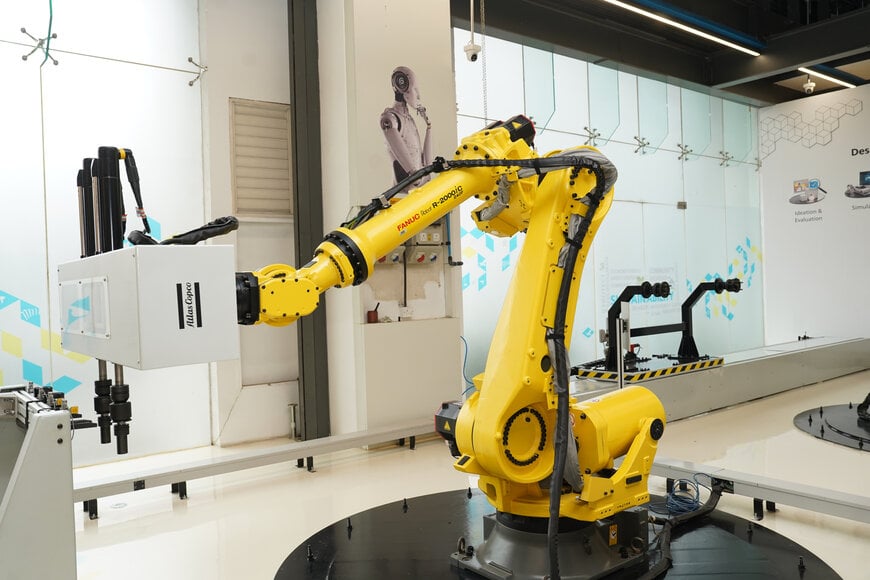
The transition toward connected production systems requires the integration of hardware mechanisms and data management platforms. During the Innovation Days 2026 event in Bavdhan, Pune, Atlas Copco Tools and Assembly Systems presented scalable manufacturing ecosystems engineered for automotive and general manufacturing applications. The showcase focused on the deployment of automated systems and screw-feeding mechanisms designed to optimize assembly line throughput and ensure process traceability.
Interconnected Assembly and Dispensing Systems
The presented manufacturing infrastructure functions as a continuous factory simulation, allowing operational assessment of synchronized production tools. The setup integrates battery-powered precision torquing tools, virtual controller networks, and vision-enabled dispensing units. Specific industrial applications, including 2D and 3D vision systems, glass glazing, ISRA glass decking, and Body-in-White (BIW) E-Swirl applications, operate within this unified network. These hardware components interface directly with the ENSO controller and ToolsNet 8 data collection software, establishing a continuous data loop for torque verification and defect prevention.
Hardware Virtualization and Process Traceability
Implementing virtual controllers reduces the physical footprint of control hardware on the shop floor while centralizing torque and angle management for multiple wireless tools simultaneously. By utilizing platforms such as ToolsNet 8, production facilities capture tightening data to monitor joint integrity, track variations, and schedule predictive maintenance. The integration of automated screw-feeding systems into the assembly line reduces cycle times and limits manual intervention, addressing operational complexity in high-volume manufacturing scenarios.
Operational Implementation and Production Strategy
Chandrashekhar Pathak, General Manager of Industrial Technique at Atlas Copco (India) Pvt Ltd., indicated that manufacturing ecosystems require continuous connectivity and flexibility. He noted that the 2026 event provides a physical simulation of how different digital and mechanical technologies operate synchronously on the shop floor, enabling industrial users to evaluate technical systems for precision, data capture, and process stability prior to full-scale facility deployment.
Additional Context: This section details technical specifications and competitive benchmarking not included in the original product announcement.
In the domain of intelligent assembly systems, Atlas Copco competes with industrial suppliers such as Bosch Rexroth, Cleco, and Desoutter. Industry standards for smart tightening tools, such as those outlined by VDI/VDE 2862, require multi-step tightening strategies with redundant measurement capabilities to guarantee safety-critical joint compliance in automotive assembly. Systems operating on virtualized controller architectures generally utilize Open Protocol standards, facilitating interoperability between assembly tools and third-party Manufacturing Execution Systems (MES). Benchmarking of these industrial platforms typically focuses on transducer accuracy, wireless communication latency over 2.4 GHz or 5 GHz bands, and the software's capacity to process high-frequency tightening curves for real-time anomaly detection.
Edited by an industrial journalist, Lekshman Ramdas, with AI assistance.
www.atlascopco.com
