
www.industry-asia-pacific.com
20
'26
Written on Modified on
AutoFlight Demonstrates 2-Ton eVTOL Logistics Transport
Autonomous electric aircraft trial in China combines air mobility with rail logistics to reduce transit time across mountainous terrain and long-distance supply chains.
www.autoflight.com
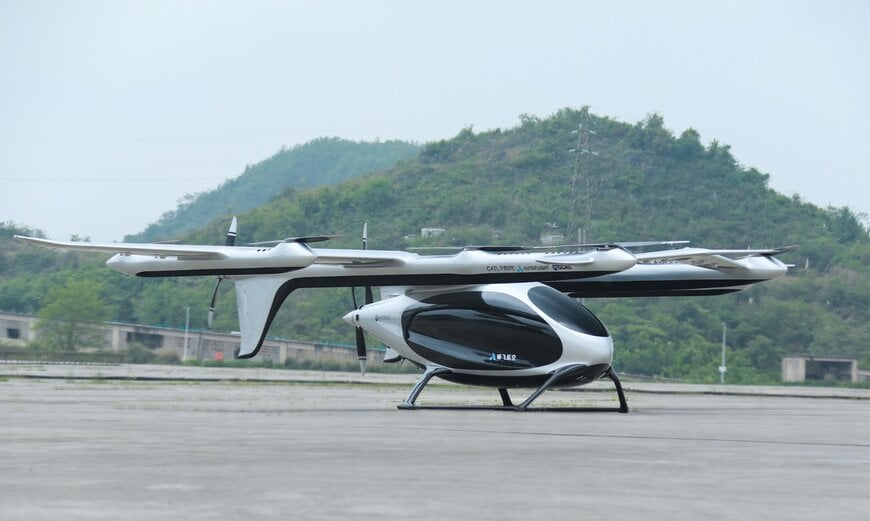
Rapid transport of time-sensitive goods in mountainous regions remains constrained by road infrastructure and terrain. In this context, AutoFlight completed a logistics trial using a 2-ton-class electric vertical take-off and landing aircraft to transport fresh tea across Guizhou province, integrating air and rail transport within a single delivery chain.
Mountain transport constraints and aerial alternative
The trial involved the CarryAll (V2000CG), an unmanned, fully autonomous eVTOL cargo aircraft, operating between Anshun and Guiyang, approximately 120 km apart. The route crosses mountainous terrain where road transport typically requires significantly longer transit times due to indirect routes and elevation changes.
The aircraft completed the journey in 37 minutes, reducing delivery time by several hours compared to ground-based logistics. The system operates without a pilot and does not require a runway, enabling point-to-point transport in regions with limited infrastructure.
Linking eVTOL with high-speed rail logistics
After the aerial segment, the cargo was transferred to a rail-based logistics network for long-distance transport from Guiyang to Shanghai, covering nearly 2,000 km. This combined “eVTOL + high-speed rail” model enabled delivery within 24 hours from remote production areas to urban markets.
Such integration illustrates how eVTOL systems can function as first-mile or mid-mile links in a broader multimodal logistics network, particularly in regions where terrain limits conventional transport efficiency.
Flight performance and operational parameters
The CarryAll (V2000CG) is designed for cargo transport across a range of logistics scenarios, including agricultural supply chains, emergency response, and remote area delivery. Its key operating parameters include a maximum payload of 400 kg, a range of up to 200 km, and a cruise speed of approximately 180 km/h.
The aircraft uses an all-electric propulsion system, resulting in zero operational emissions and reduced noise levels compared to conventional rotorcraft. Autonomous flight capability removes the need for onboard crew, supporting consistent operations and reducing dependency on pilot availability.
Certification status and deployment scope
The CarryAll (V2000CG) is reported to be the first 2-ton-class eVTOL aircraft to obtain Type Certificate (TC), Production Certificate (PC), and Airworthiness Certificate (AC) from the Civil Aviation Administration of China (CAAC). These certifications establish compliance with regulatory requirements for design, manufacturing, and operational safety.
AutoFlight has conducted additional operational trials in scenarios such as offshore platform logistics, intercity cargo transport, and emergency response. The company is also progressing certification of its passenger eVTOL model V2000EM Prosperity, which is in Phase IV compliance verification with CAAC.
Implications for digital supply chain logistics
The trial demonstrates how autonomous eVTOL systems can be integrated into a digital supply chain to address geographic bottlenecks and reduce delivery times for perishable goods. By combining short-range aerial transport with high-speed ground networks, the model supports faster distribution while maintaining product quality, particularly for agricultural goods requiring rapid handling after harvest.
Edited by Aishwarya Mambet, Induportals Editor, with AI assistance.
www.autoflight.com
