
www.industry-asia-pacific.com
05
'26
Written on Modified on
Panasonic Avionics, Spacesail Expand Global LEO Connectivity
A new agreement enables Panasonic Avionics to integrate a Low Earth Orbit satellite constellation from Shanghai Spacesail Technologies into its multi-orbit in-flight connectivity network.
www.panasonic.aero
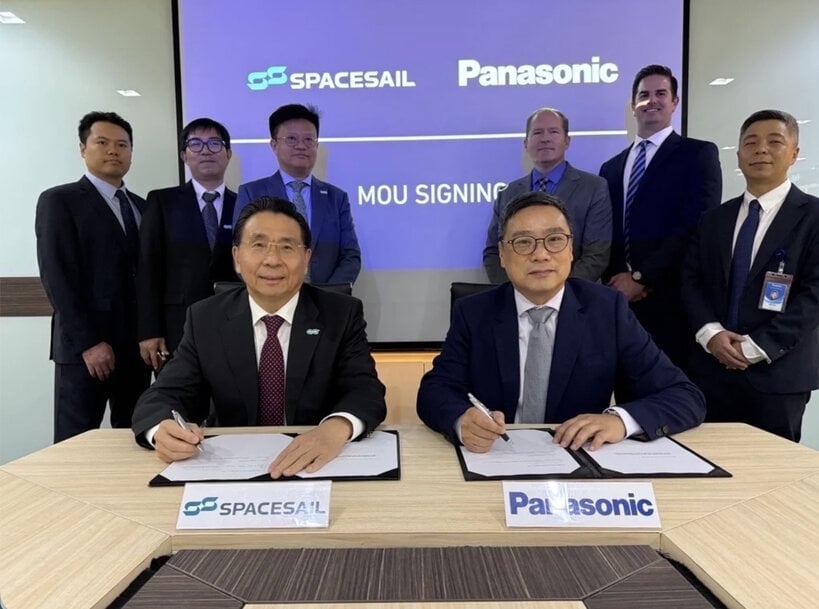
For commercial aviation, business aviation, and long-haul international operations, in-flight connectivity performance increasingly depends on global coverage, low latency, and network resilience. To address these requirements, Panasonic Avionics Corporation has signed a memorandum of understanding with Shanghai Spacesail Technologies to evaluate the integration of Spacesail’s Low Earth Orbit (LEO) satellite constellation into its worldwide in-flight connectivity infrastructure.
Announced at the Singapore Air Show, the agreement allows both companies to immediately begin technical and operational planning to make LEO-based connectivity available to airlines and passengers across global flight routes.
Strengthening multi-orbit in-flight connectivity
Panasonic Avionics’ connectivity strategy is based on combining multiple satellite orbits to improve coverage and service continuity. The potential addition of Spacesail’s LEO constellation is intended to complement existing GEO and LEO assets, including Panasonic Avionics’ established partnerships in other regions. Of particular relevance is Spacesail’s planned high-bandwidth, low-latency constellation with coverage over China, a region where uninterrupted in-flight connectivity has historically been challenging for global operators.
By incorporating a LEO network operating over Chinese airspace, Panasonic Avionics aims to provide more consistent connectivity performance on intercontinental routes, supporting airline requirements for uniform passenger experience regardless of geography.
Technical integration and network architecture
The planned collaboration aligns with Panasonic Avionics’ ongoing development of a next-generation antenna, terminal, and onboard compute ecosystem. This architecture is designed to support channel bonding across multiple satellite networks, frequency bands, and orbital layers. In practice, this allows aircraft systems to dynamically combine capacity from different satellites to improve throughput, reduce latency, and increase resilience in the event of localized network constraints.
Spacesail’s constellation is designed to deliver broadband connectivity suitable for a range of industries. Within aviation, its low-latency characteristics are particularly relevant for real-time applications, such as cloud-based services, streaming, and operational data exchange during all phases of flight.
Implications for airlines and passengers
For airlines, the integration of an additional LEO provider expands network redundancy and flexibility while reducing dependence on a single orbital layer. For passengers, this translates into more stable connections, especially on long-haul routes spanning multiple regulatory and coverage zones.
Panasonic Avionics has maintained a strong position in the Asia-Pacific connectivity market for more than a decade, supported by GEO coverage and regional partnerships. The potential inclusion of Spacesail’s LEO services further reinforces its role as a managed connectivity provider, including within Airbus’ HBCplus ecosystem, where multi-orbit capability is a key technical requirement.
The agreement marks another step toward scalable, globally consistent in-flight connectivity architectures designed to meet the performance expectations of modern aircraft, airlines, and digitally connected passengers.
www.panasonic.aero
