
www.industry-asia-pacific.com
03
'26
Written on Modified on
Open Fan Engine Readiness for Airport Operations
Civil Aviation Authority of Singapore, CFM International and Airbus will assess next-generation engine operations in Singapore’s airport environment.
www.airbus.com
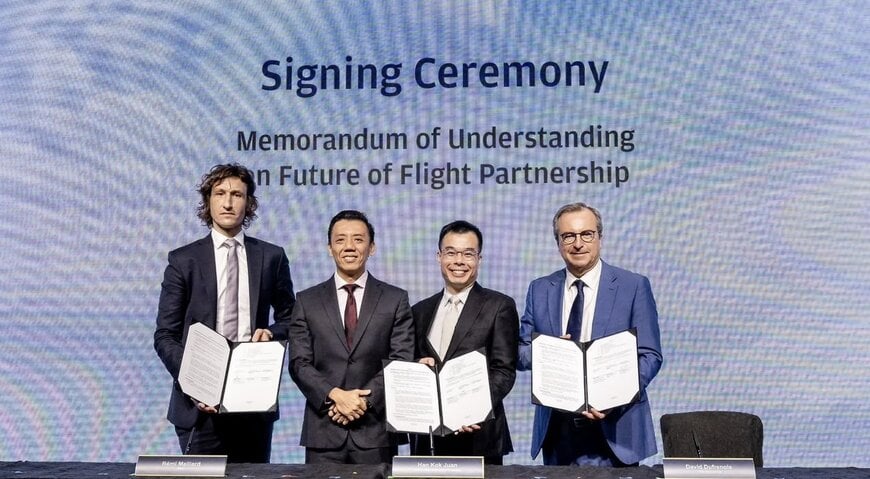
Singapore has been selected as the first global testbed to evaluate how next-generation Open Fan aircraft engines could be integrated into existing airport operations, infrastructure, and regulatory frameworks.
Establishing an airport-scale test environment
The Civil Aviation Authority of Singapore, CFM International and Airbus have signed a Memorandum of Understanding to establish Singapore as the world’s first airport testing ground for CFM’s Revolutionary Innovation for Sustainable Engines (RISE) technologies. The agreement was signed at the 3rd Changi Aviation Summit on 2 February 2026 and focuses primarily on the Open Fan engine architecture.
The objective is to study the operational impact of Open Fan and other RISE technologies on airport environments and to develop a structured readiness framework. This framework is intended to serve as a global reference for aircraft manufacturers, airports, and airlines preparing for the introduction of next-generation propulsion systems.
Technical scope of the RISE Open Fan programme
The RISE programme is a technology demonstration initiative aimed at advancing future commercial aircraft engine concepts. Its most prominent feature is the Open Fan architecture, which removes the traditional nacelle surrounding the fan. By eliminating the casing, the design allows for a larger fan diameter with reduced aerodynamic drag, improving propulsive efficiency.
CFM has stated that the RISE technologies target more than 20% improvement in fuel efficiency compared with current commercial engines in service. In addition to fuel burn reduction, the Open Fan concept is being developed to lower CO₂ emissions, reduce noise, and maintain compatibility with future hybrid-electric propulsion systems. These characteristics position the technology as a candidate for next-generation narrow-body aircraft.
Assessing implications for airport operations
A central element of the collaboration is the development of a comprehensive readiness framework for integrating Open Fan–powered aircraft into existing airport operations. This includes evaluating aircraft system and design considerations, potential infrastructure modifications, operational procedure changes, safety requirements, and regulatory processes.
Unlike conventional turbofan engines, Open Fan architectures may introduce new considerations related to airflow patterns, noise distribution, ground safety zones, and maintenance procedures. Studying these factors at an operational airport scale is intended to provide data-driven guidance for managing risks while preserving safety and efficiency.
Leveraging Singapore’s aviation ecosystem
The partners will draw on Singapore’s established aviation ecosystem to exchange technical and operational expertise. This includes airport design, safety management systems, regulatory oversight, and day-to-day operational practices. The aim is to ensure that the readiness framework reflects real-world constraints faced by airports and operators rather than remaining a purely conceptual exercise.
Operational trials of RISE Open Fan engine demonstrators are planned at either Singapore Changi Airport or Seletar Airport. These trials are intended to validate the readiness framework and assess the feasibility of Open Fan operations within active airport environments.
Broader industry relevance
By addressing airport compatibility early in the technology development cycle, the initiative seeks to reduce uncertainty around the deployment of next-generation propulsion systems. For the global aviation sector, the resulting framework is expected to inform future certification pathways, airport planning decisions, and airline fleet strategies as Open Fan technologies move closer to commercial application.
www.airbus.com
