
www.industry-asia-pacific.com
23
'26
Written on Modified on
Modular Liquid-Cooled IT POD Architecture for AI Data Centers
ZTE introduces an integrated micro-module framework featuring hybrid air-and-liquid cooling to support escalating rack power densities in artificial intelligence workloads.
www.zte.com.cn
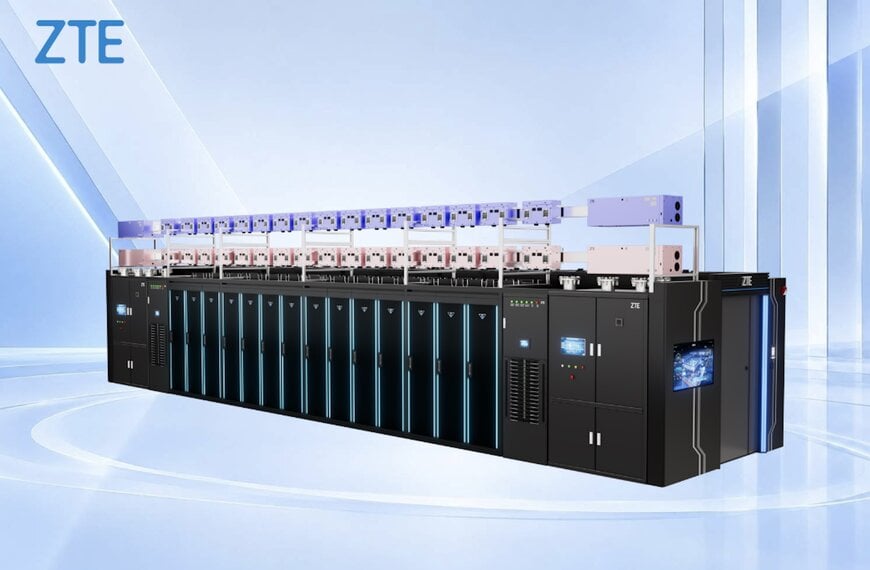
ZTE Corporation is releasing the ZXEDC M8000 Intelligent Computing Micro-Module, a standardized IT POD framework designed to manage escalating thermal loads and high-voltage power distribution in modern AI data centers. Introduced at Data Center World Asia (29–30 September 2026), the architecture provides a scalable foundation for global facilities transitioning from traditional air cooling to high-density liquid cooling environments.
Managing Rack Power Density and Cooling Transitions
The surge in artificial intelligence computing has driven rack power densities beyond the capacity of traditional cooling. The M8000 addresses this by integrating coldplate liquid cooling coolant distribution units (CDUs), secondary-side piping, and thin-sheet air walls into a unified architecture. Operating with a dynamically adjustable air-to-liquid cooling ratio, the system manages standard thermal loads of 20 to 60 kilowatts (kW) per rack, while accommodating peak configurations of up to 250 kW per rack.
Lifecycle Scalability and Intelligent Operations
The architecture decouples the physical racks from the main structural frame, accommodating both full-size and special-form-factor servers. This modularity allows facilities to deploy air cooling initially and execute on-site air-to-liquid retrofits as compute requirements escalate, supporting up to three generations of IT hardware upgrades without requiring large-scale structural modifications. Operational management is handled via the iDCIM platform, which uses artificial intelligence algorithms to optimize the cooling load factor (CLF) and reduce energy consumption by over 10%, enabling a Power Usage Effectiveness (PUE) as low as 1.15 in favorable climates.
Power Distribution and System-Level Safety
For electrical distribution, the micro-module utilizes an 800V high-voltage direct current (HVDC) system paired with intelligent busbars. This configuration provides flexible in-row power supply delivery directly to the racks, achieving up to 98% power supply efficiency. To mitigate the physical risks associated with liquid cooling, the M8000 holds a UL system-level leak-proof certification. Its full-chain leak protection encompasses the CDU, liquid-cooled racks, servers, and network switches, utilizing automated leak detection and liquid replenishment mechanisms to safeguard infrastructure investments.
Additional Context
This section details technical specifications and competitive benchmarking not included in the original news release.
Within the data center micro-module and high-density cooling sector, the ZTE ZXEDC M8000 competes with prefabricated IT PODs and liquid-cooled architectures from Schneider Electric, Vertiv, and Huawei. While Schneider Electric leverages its integration of Motivair technology to deliver specialized liquid-to-liquid CDUs and direct-to-chip cooling for ultra-dense AI clusters, ZTE differentiates the M8000 through its highly integrated hybrid approach. By combining 800V HVDC power distribution with dynamically adjustable air-and-liquid cooling ratios within a single decoupled frame, the ZTE platform prioritizes brownfield transition flexibility—allowing operators to install air-cooled chassis initially and retrofit liquid loops on-site as rack densities approach the 250 kW threshold.
Edited by Aishwarya Mambet, Induportals Editor, with AI assistance.
www.zte.com
