
www.industry-asia-pacific.com
01
'26
Written on Modified on
Multi-Variable Environmental Sensors for Smart Building Management
Schneider Electric has engineered a series of intelligent environmental sensors designed to integrate with HVAC systems for precise indoor climate control.
www.se.com
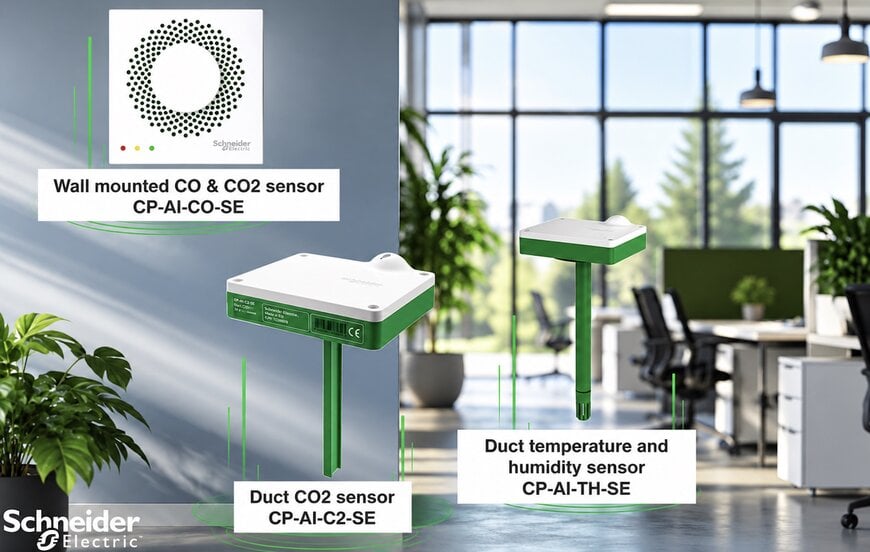
Schneider Electric released the EasyLogic Air Quality Sensors, an IoT-enabled hardware series designed to monitor indoor environmental quality across commercial and industrial facilities. By integrating directly with building management systems (BMS), these devices enable real-time ventilation adjustments to mitigate the health risks associated with poor air circulation.
Mitigating Sick Building Syndrome
In modern commercial infrastructure, heavy reliance on closed-loop air conditioning and ventilation systems frequently limits the intake of fresh outdoor air. Data from the Thailand Institute for Occupational Safety, Health and Environmental Protection (T-OSH) indicates that this lack of ventilation contributes directly to Sick Building Syndrome, a condition manifesting as respiratory irritation, headaches, and occupant discomfort. The EasyLogic sensors address this structural issue by continuously measuring temperature, humidity, carbon dioxide (CO2), and carbon monoxide (CO) levels. This data is transmitted to centralized HVAC controllers, allowing the system to dynamically adjust airflow and introduce outside air based on real-time occupancy and environmental conditions.
Sensor Architecture and Specifications
The sensor lineup is engineered for both wall-mounted and ducted installations. The CO2 sensors utilize dual-channel Non-Dispersive Infrared (NDIR) technology, measuring concentrations from 0 to 2000 parts per million (ppm) with an accuracy of ±50 ppm and ±3 percent. These units feature automatic baseline calibration to minimize manual maintenance and compensate for long-term drift.
For thermal monitoring, the duct-mounted temperature and humidity module operates across a -40 to 60 degrees Celsius range and measures 0 to 100 percent relative humidity with a 2 percent accuracy margin. This specific module supports both PT1000 and NTC 10K thermistors, achieving a rapid response time of 20 seconds. Additionally, a wall-mounted CO sensor monitors concentrations from 0 to 250 ppm with a ±5 percent accuracy. It utilizes a three-color LED array to provide an immediate visual safety assessment in high-risk areas, such as parking garages and machine rooms.
System Integration and Certifications
To facilitate integration with diverse smart building management networks, the hardware supports 24VAC, 24VDC, and 12-30VDC power supplies and communicates via standard 0-10V or 4-20mA analog outputs. The duct-mounted units are rated IP65 for dust and water resistance, while the wall-mounted CO monitor carries an IP30 rating. The series complies with CE (EMC), RoHS, and REACH standards, and provides the necessary environmental data logging to support global green building certifications, including LEED, the WELL Building Standard, and RESET.
Additional Context
This section details technical specifications and competitive benchmarking not included in the original news release.
In the commercial building automation market, environmental sensors are primarily benchmarked on measurement technology, calibration drift, and integration protocols. The EasyLogic series competes directly with established HVAC sensor lines such as the Siemens Symaro and Honeywell TR series. While single-channel NDIR sensors are common in entry-level commercial applications, they rely heavily on software-based automatic baseline correction that assumes a building is fully unoccupied (allowing ambient CO2 to drop to approximately 400 ppm) at least once a week. By employing dual-channel NDIR technology, the Schneider Electric CO2 sensors utilize a secondary reference channel to continuously measure the degradation of the infrared light source. This hardware-driven approach inherently prevents long-term calibration drift, making it suitable for facilities that operate continuously, such as hospitals or data centers. Furthermore, the reliance on standard 0-10V and 4-20mA analog signals ensures backward compatibility with legacy programmable logic controllers, though it requires individual wiring per sensor compared to digital daisy-chained protocols like BACnet MS/TP or Modbus RTU found in more complex sensor networks.
Edited by Aishwarya Mambet, Induportals Editor, with AI assistance.
www.se.com
