
www.industry-asia-pacific.com
30
'26
Written on Modified on
Hollow Fiber Nanofiltration Technology for Municipal Wastewater Reuse
NX Filtration deploys its NX Nano hollow fiber nanofiltration modules at New Delhi’s Okhla plant to eliminate micropollutants from municipal effluent.
www.nxfiltration.com
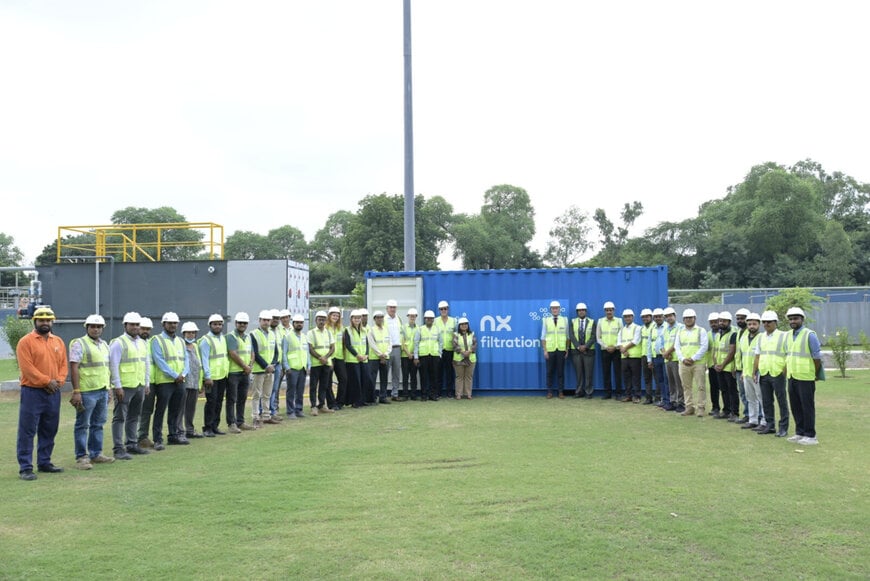
Rapid urban expansion and depleted freshwater aquifers require municipal utilities to treat secondary sewage into circular industrial-grade and non-potable water supplies. Addressing this municipal water reclaim challenge, NX Filtration demonstrated its hollow fiber nanofiltration system at the Okhla wastewater treatment plant in New Delhi, validating a direct, low-pressure membrane pathway for municipal effluent reuse.
Decentralized Tertiary Polishing and Micropollutant Removal
Conventional municipal wastewater treatment plants relying on activated sludge or sequencing batch reactors routinely meet basic biological oxygen demand and total suspended solids limits, but they fail to eliminate persistent trace organics. Pharmaceutical residues, endocrine disruptors, surfactants, and industrial chemicals pass through secondary clarifiers directly into urban river basins.
The demonstration project at the Okhla facility targets this tertiary treatment barrier by introducing NX Filtration NX Nano membrane modules as a selective filtration stage. Operating as part of the Indo-Dutch Centre of Excellence on Water initiative, the project represents an intergovernmental deployment developed in partnership with India’s National Mission for Clean Ganga (NMCG) and the Embassy of the Kingdom of the Netherlands. Engineering execution and system delivery were conducted by Ceramed, an Indian engineering firm with over 35 years of industrial experience.
On 25 September 2026, an official delegation comprising India’s Union Minister of Jal Shakti, Shri C.R. Patil, and drs. J.H. (Jaap) Slootmaker RO, Director-General for Water and Soil at the Ministry of Infrastructure and Water Management of the Netherlands, visited the Okhla installation during India International Water Week (IIWW) 2026 to review field operational metrics.
Hollow Fiber Fluid Dynamics and Direct Membrane Separation
Traditional nanofiltration and reverse osmosis systems require multi-stage pre-treatment—such as coagulation, flocculation, and ultrafiltration—to prevent particulate fouling in narrow feed spacer channels. In contrast, the NX Nano technology employs an inside-out hollow fiber geometry based on modified polyethersulfone (PES).
Feed water enters the lumen of the hollow fibers, where fluid shears parallel to the membrane wall, minimizing cake layer formation on the active layer. Because the fiber lumen contains no mesh spacers, the module can receive biologically treated secondary effluent directly, tolerating suspended organic solids that would cause irreversible fouling in spiral-wound elements.
The selective separation layer removes dissolved natural organic matter, color, microplastics, and micropollutants in a single physical step. Furthermore, the tubular hollow fiber structure supports hydraulic backwashing with water and standard cleaning agents, restoring operational permeability without requiring continuous chemical dosing.
Alignment with National Urban Water Reuse Frameworks
The Okhla demonstration aligns with urban water security mandates set under India’s national AMRUT 2.0 (Atal Mission for Rejuvenation and Urban Transformation) program. AMRUT 2.0 mandates cities to recycle treated sewage to meet at least 20 percent of total urban water demand and 40 percent of industrial water demand, relieving extraction pressure on stressed surface reservoirs and alluvial aquifers. Incorporating compact, low-pressure membrane units into existing municipal infrastructure allows utilities to upgrade decentralized treatment plants into regional water reclamation hubs.
Additional Context:
This section details technical specifications and competitive benchmarking not included in the original product announcement.
Hollow fiber nanofiltration (HFNF) operates in the separation spectrum between ultrafiltration (UF) and reverse osmosis (RO). NX Filtration NX Nano modules feature a molecular weight cut-off (MWCO) between 400 and 800 Daltons, corresponding to an effective pore diameter of approximately 1 to 2 nanometers. This pore distribution achieves greater than 80 to 90 percent rejection of multivalent ions and heavy dissolved organic molecules while operating at low transmembrane pressures ranging from 2 to 6 bar, with clean water design flux rates typically between 15 and 35 liters per square meter per hour (LMH).
In municipal tertiary treatment benchmarks, HFNF addresses specific operational limitations found in conventional spiral-wound reverse osmosis and ultrafiltration:
- Pressure and energy demand: Brackish water reverse osmosis (BWRO) typically operates at pressures between 10 and 25 bar to overcome osmotic pressure and drive separation, consuming substantial pumping energy while removing all monovalent mineral salts. HFNF operates at 2 to 6 bar, lowering specific energy consumption while preserving non-scaling monovalent ions suitable for industrial cooling or urban irrigation.
- Fouling mechanics: Spiral-wound reverse osmosis and standard spiral nanofiltration modules utilize polymeric feed spacer meshes that entrap suspended colloids and bio-solids, requiring rigorous pre-treatment (turbidity less than 0.2 NTU and Silt Density Index under 3). The inside-out hollow fiber configuration operates without feed spacers, accommodating feed turbidity spikes and allowing direct hydraulic backwashing.
- Organic retention vs. ultrafiltration: Ultrafiltration membranes possess larger pores (MWCO of 10 to 150 kilodaltons), making them effective for suspended solids, bacteria, and virus retention, but completely permeable to dissolved micropollutants, per- and polyfluoroalkyl substances (PFAS), and endocrine disruptors. HFNF provides a physical molecular barrier to these micropollutants without requiring supplementary powdered activated carbon (PAC) adsorption stages.
