
www.industry-asia-pacific.com
25
'26
Written on Modified on
Microchip Introduces Energy-Aware 65V Monitors for Resilient 48V Systems
PAC1761 and PAC1861 track accumulated energy, detect load changes and protect against voltage spikes across automotive, data center and industrial applications.
www.microchip.com

Microchip Technology introduced the PAC1761 and PAC1861 families of high-voltage digital power monitoring integrated circuits. The semiconductor devices provide energy-aware telemetry and transient spike suppression for 48-volt direct current distribution topologies in automotive, computational data center, networking, and industrial power infrastructure.
Voltage Headroom and Transient Spike Protection
Transitioning intermediate bus architectures from 12 volts to 48 volts lowers resistive distribution losses by a factor of sixteen for equivalent current densities. Operating at nominal 48-volt potentials requires sensing silicon with sufficient electrical clearance to tolerate inductive kickback and load-dump voltage transients without external clamping failure.
The PAC1761 and PAC1861 integrate sensing inputs rated for operational measurements up to 65 volts direct current alongside transient spike withstand ratings reaching 75 volts. This measurement headroom prevents front-end monitor saturation during rapid load transitions while preserving signal fidelity across high-side current-sensing topologies.
Energy Accumulation and Automated Dynamic Alerting
In contrast to conventional point-in-time monitors that continuously poll instantaneous rail metrics, these devices integrate internal energy accumulators to calculate energy metrics over user-defined integration periods. By shifting basic arithmetic summation onto the sensing silicon, the architecture offloads periodic calculation overhead from the host microprocessor and eliminates quantization errors associated with variable bus polling intervals.
The integrated monitoring logic supports autonomous step-limit detection to isolate rapid load transients, accompanied by configurable digital alerts for current, voltage, and total power deviations. Keith Pazul, Vice President of Microchip's Mixed-Signal Linear Business Unit, indicated that integrating accumulated power data directly into the sensing node allows power architectures to track energy behavior dynamically across operating lifecycles while simplifying circuit design via pin-compatible footprints.
Target Infrastructure and Hardware Integration Options
The monitoring integrated circuits address high-reliability power domains, including automotive zonal controllers, artificial intelligence server accelerator trays, telecommunications infrastructure, Power over Ethernet switches, and 48-volt industrial automation backplanes.
The product series is differentiated by measurement resolution and enclosure format. The 12-bit analog-to-digital converter architecture of the PAC1761 and the 16-bit analog-to-digital converter engine of the PAC1861 are supplied in VDFN-8, VDFN-10, and MSOP-10 packages, including AEC-Q100 qualified automotive grades. Shared pinout compatibility between the 12-bit and 16-bit variants allows hardware developers to scale measurement precision without revising printed circuit board routing.
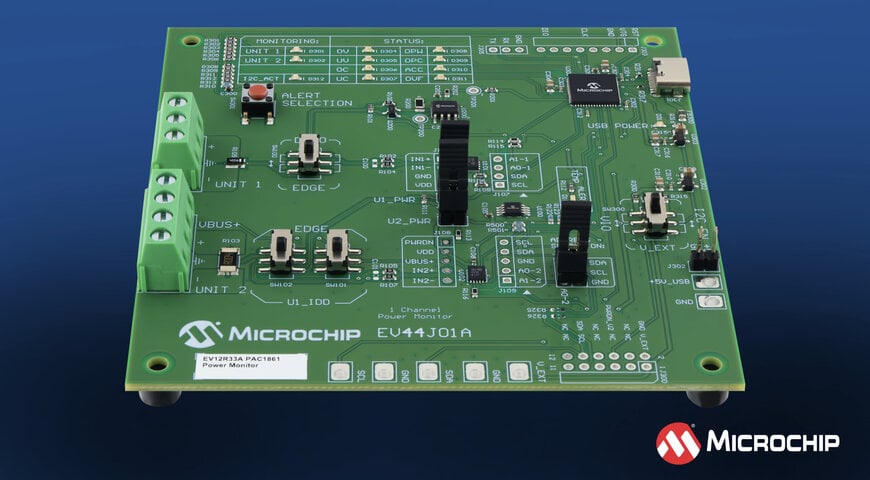
Development support tools include the EV12R33A hardware evaluation board, a Python command line interface utility, native Linux kernel drivers, and generic C firmware libraries configured for standard microcontroller integration.
Additional Context:
This section details technical specifications and competitive benchmarking not included in the original product announcement
Digital power monitors operating on 48-volt bus architectures are evaluated on operational input voltage range, transient withstand ceiling, analog-to-digital converter resolution, and host communications efficiency. Direct market alternatives include the Texas Instruments INA228 and INA229, as well as the Analog Devices LTC2944 and LTC2949.
The Texas Instruments INA228 features a 20-bit delta-sigma converter with an operational common-mode input voltage range spanning negative 0.3 volts to positive 85 volts, delivering current measurement resolution with an input offset voltage of 1 microvolt and a maximum gain error of 0.05 percent. While the INA228 provides an internal 40-bit energy accumulator and an integrated temperature sensor over standard I2C and SMBus interfaces, the Microchip PAC1861 focuses on rapid integration via a 16-bit successive approximation register conversion core with 75-volt transient survivability, reducing digital filtering latency during high-frequency automotive transients.
Analog Devices offers the LTC2944, a multi-cell battery and bus monitor with an operating input window spanning 3.8 volts to 55 volts, which remains below the 65-volt operating threshold of the PAC1761 and PAC1861 and limits direct headroom in automotive 48-volt networks subjected to ISO 21780 overvoltage testing. The high-voltage Analog Devices alternative, LTC2949, scales up to 14.5 volts to 1,000 volts for traction packs, using dual 20-bit delta-sigma converters, but requires substantial external biasing circuits and isolated serial peripheral interfaces compared to the low-profile VDFN packaging of the Microchip components.
The PAC1761 and PAC1861 differentiate primarily through their step-limit thresholding logic, which generates an interrupt when instantaneous current divergence exceeds a programmable rate-of-change limit, enabling power supplies to execute fast phase shedding or dynamic voltage scaling faster than standard I2C polling intervals permit.
Edited by Natania Lyngdoh, Induportals editor, assisted by AI.
www.microchip.com
