
www.industry-asia-pacific.com
15
'26
Written on Modified on
FEIG Expands RFID Access Control Portfolio with OSDP-Capable UHF Reader
ID LRU500i-BD combines integrated antenna and traffic light function with bidirectional OSDP and Wiegand support for flexible vehicle access applications.
www.feig.de
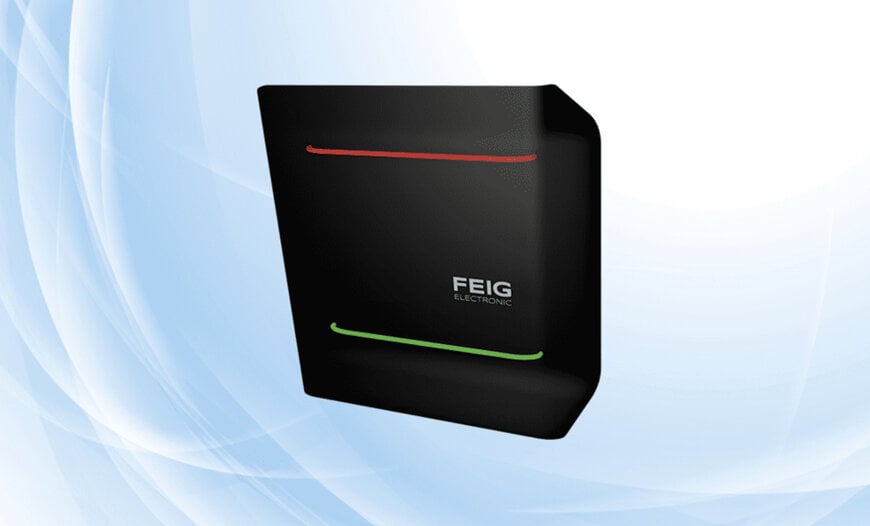
FEIG ELECTRONIC has expanded its radio frequency identification portfolio by adding Open Supervised Device Protocol support to the ID LRU500i-BD compact ultra-high frequency reader. The hardware integration provides secure, bidirectional device communications for automatic vehicle identification across industrial plant entrances, commercial parking facilities, and security-critical logistics hubs.
Supervised Communication Protocols in Physical Access Control
Securing perimeter vehicle gates and commercial access points traditionally relied on unidirectional communication architectures, primarily legacy Wiegand wiring interfaces. Wiegand channels transmit unencrypted credential data from external gate readers to central access controllers, leaving access infrastructures vulnerable to signal eavesdropping, physical line interception, and credential replay attacks. In addition, unidirectional lines cannot transmit reader operational health data, diagnostic faults, or tamper notifications back to the building security management system.
The integration of Open Supervised Device Protocol (OSDP) establishes standardized, bidirectional serial communication between the ID LRU500i-BD reader and host security controllers over an RS-485 bus. Standardized under IEC 60839-11-5, OSDP replaces proprietary wiring with supervised monitoring that continuously tracks reader health, physical connection integrity, and sabotage events. The standard also provides multi-vendor interoperability, allowing operators to deploy high-frequency barrier systems without lock-in to proprietary controller ecosystems.
Integrated Antenna Architecture and Traffic Signaling
The ID LRU500i-BD functions as an integrated single-unit reading station engineered specifically for barrier gates, access bollards, and restricted vehicle checkpoints. The hardware encloses an ultra-high frequency radio module alongside an internal circularly polarized antenna, ensuring transponder detection regardless of vehicle tag orientation on windshields or headlamps.
To regulate traffic flow at entry points, the unit embeds direct visual signaling via an integrated red and green indicator light. This built-in traffic light functionality provides visual clearance cues directly to approaching drivers, eliminating external signal pole installations and simplifying field wiring. To facilitate phased migration across facility lifecycles, the reader maintains concurrent support for both legacy Wiegand systems and modern OSDP channels, allowing facility operators to modernize access controller hardware without replacing field-level optical sensors or gate mechanisms.
Logistics and Perimeter Vehicle Flow Tracking
Deployments across high-throughput industrial sites, automated freight centers, and regulated perimeter boundaries rely on reliable non-stop vehicle clearing. By pairing long-range passive transponder detection with bidirectional supervised signaling, facility systems confirm credential authentication, actuate gate barriers, and update logistics database entries while commercial vehicles remain in motion. The architecture prevents queue congestion at distribution terminals while maintaining an auditable access chain of custody across security zones.
Additional Context:
This section details technical specifications and competitive benchmarking not included in the original product announcement
The FEIG ELECTRONIC ID LRU500i-BD operates across regional ultra-high frequency bands, spanning 865 to 868 megahertz for European telecommunications standards and 902 to 928 megahertz under Federal Communications Commission allocations. The unit delivers an internal radiated output power up to 2 watts effective radiated power (ERP) and incorporates one external reverse-TNC connector configurable up to 1 watt conducted power for auxiliary antenna arrays. The device provides passive transponder detection ranges up to 10 meters, compliant with EPC Class 1 Gen 2 (ISO 18000-6C) and RAIN RFID protocols. Constructed in an ASA-PC plastic and aluminum housing measuring 290 by 290 by 100 millimeters with a mass of 2.8 kilograms, the reader carries an IP67 ingress protection rating, operates across ambient temperatures from -35 to +55 degrees Celsius, and is powered via a 12 to 24 volt direct-current supply or Power over Ethernet Plus (PoE+).
Within the automatic vehicle identification sector, an established benchmark platform utilizing long-range ultra-high frequency reading and OSDP capability is the Nedap uPASS Target.
The Nedap uPASS Target operates across identical frequency bands (865 to 868 megahertz and 902 to 928 megahertz) and supports passive EPC Gen 2 tags at read distances up to 10 meters, extendable to 15 meters depending on transponder selection. The unit incorporates OSDP version 2 with Secure Channel Protocol (SCP) utilizing 128-bit AES encryption over RS-485 lines, alongside Wiegand and PoE+ connectivity. Encased in an aluminum chassis with an ABS cover measuring 286 by 285 by 78 millimeters and weighing 3.5 kilograms, the uPASS Target features an IP66 enclosure rating and an operating temperature range of -30 to +60 degrees Celsius. While the uPASS Target utilizes high-intensity tri-color LED status indicators to signal tag read confirmation, the FEIG ID LRU500i-BD provides a dedicated high-visibility signaling beacon designed to function as an active traffic light for vehicle queue management, accompanied by a higher IP67 ingress protection rating for continuous submersibility resistance in harsh outdoor environments.
Edited by Natania Lyngdoh, Induportals editor, assisted by AI.
www.feig.com
