
www.industry-asia-pacific.com
07
'26
Written on Modified on
The Industrial Metaverse: From Virtual Worlds to Real-World Industry
The industry is building a collection of interconnected digital environments that increasingly mirror physical assets and processes.
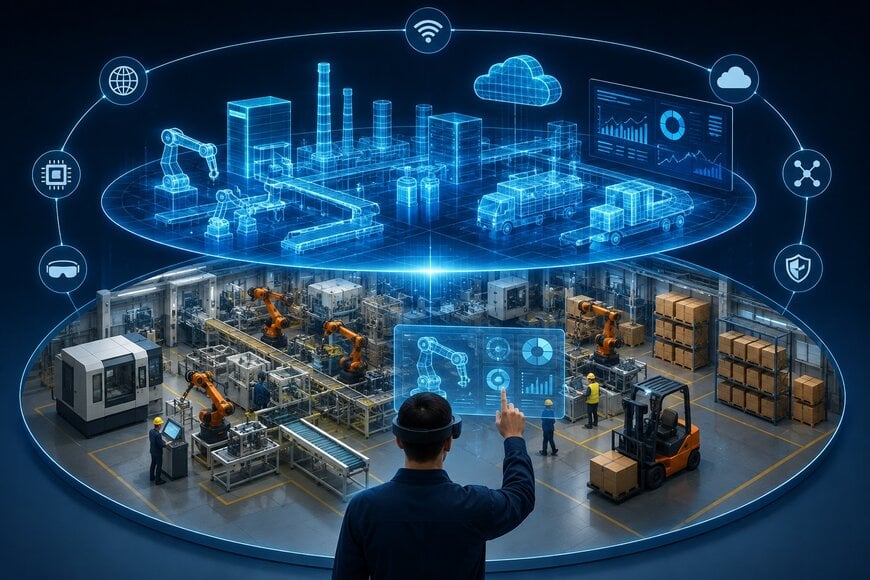
The metaverse may have lost some of its consumer-world hype, but in industry its underlying technologies are becoming increasingly practical. What is emerging is not a virtual replacement for the factory, plant or infrastructure asset, but a persistent digital environment in which physical assets can be designed, simulated, monitored, optimised and, increasingly, operated.
The Industrial Metaverse brings together digital twins, artificial intelligence and machine learning, the Internet of Things (IoT), extended and mixed reality (XR/MR), high-performance computing, edge computing and advanced connectivity such as 5G. Together, these technologies create a bridge between the physical and digital worlds.
The question, however, is whether this convergence is actually working as envisaged. The answer in 2026 is increasingly yes – but selectively. The technology has moved beyond demonstrations in several areas, particularly factory planning, simulation, robotics, training and remote collaboration. Yet the fully immersive, continuously synchronised industrial metaverse remains a work in progress.
From digital twin to industrial metaverse
The digital twin is arguably the foundation of the industrial metaverse. A conventional digital twin creates a digital representation of a machine, production line, building or process. When connected to live operational data, it becomes much more powerful: engineers can compare actual performance with the virtual model, simulate changes and predict the consequences before making physical interventions.
The industrial metaverse adds another dimension – interaction and collaboration. Engineers, operators, designers and managers can enter the same digital environment, examine a machine or production line from different locations, manipulate virtual equipment and evaluate alternatives in real time.
Siemens describes the industrial metaverse as a persistent environment combining real-time, physics-based simulation with digital twins, collaboration and data-driven decision-making. Its latest Digital Twin Composer is designed to combine Siemens' industrial digital-twin capabilities with NVIDIA Omniverse libraries and real-world engineering data.
This represents an important change in thinking. Instead of using a digital twin simply as a sophisticated engineering model, companies are beginning to treat it as a living operational environment.
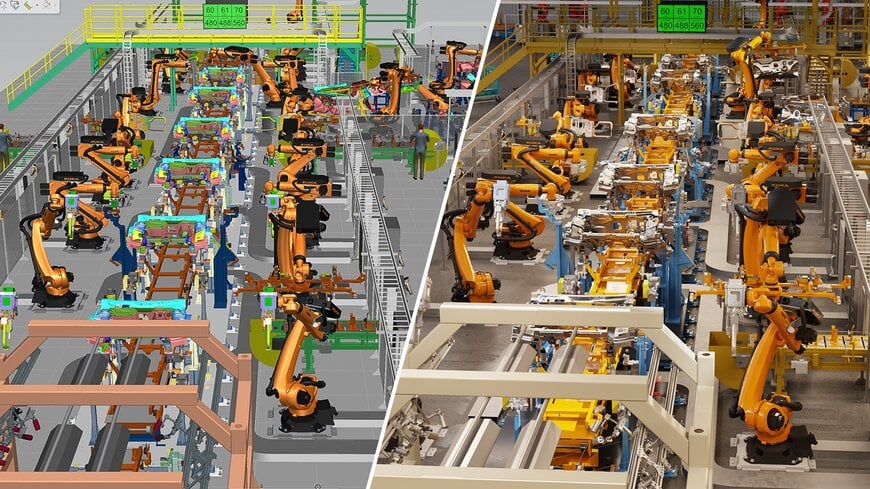
Siemens Process Simulate (left) connects to NVIDIA Omniverse (right) to enable a full-design-fidelity, photorealistic, real-time digital twin. Image: Nvidia
AI gives the virtual world intelligence
A digital model alone cannot make an industrial metaverse intelligent. That role increasingly belongs to AI and machine learning.
IoT sensors continuously generate information about temperature, vibration, energy consumption, production rates, equipment condition and material movement. AI algorithms can analyse this data, identify patterns and predict likely outcomes. When these models are connected to a digital twin, engineers can test potential decisions virtually.
This creates a powerful feedback loop:
Physical Asset → IoT Data → Digital Twin → AI/ML Analysis → Simulation → Decision → Physical Action
The next stage is the use of AI agents that can perform portions of this process autonomously. Instead of an engineer manually testing every production scenario, an AI system can simulate alternatives, identify bottlenecks and recommend an optimum configuration.
The Siemens-NVIDIA partnership illustrates this direction, combining Siemens' industrial software and digital-twin technologies with NVIDIA's Omniverse simulation and accelerated computing capabilities. In 2026, Siemens announced its Digital Twin Composer as a technology intended to scale industrial-metaverse applications and support AI-driven simulation and decision-making.
Where the industrial metaverse is already delivering
One of the strongest use cases is factory planning.
BMW has developed a Virtual Factory using NVIDIA Omniverse and OpenUSD. Its planners can work inside digital representations of factories, evaluating layouts, production processes, logistics, robotics and equipment before changes are implemented physically. BMW says its virtual factories cover more than 30 production sites, with projected reductions of up to 30% in production-planning costs.
This is a significant indication of where the industrial metaverse delivers genuine value: fail virtually rather than physically.
Potential collisions between equipment can be identified before installation. Robot positions can be optimised. Material flows can be simulated. Production changes can be evaluated without stopping the actual factory.
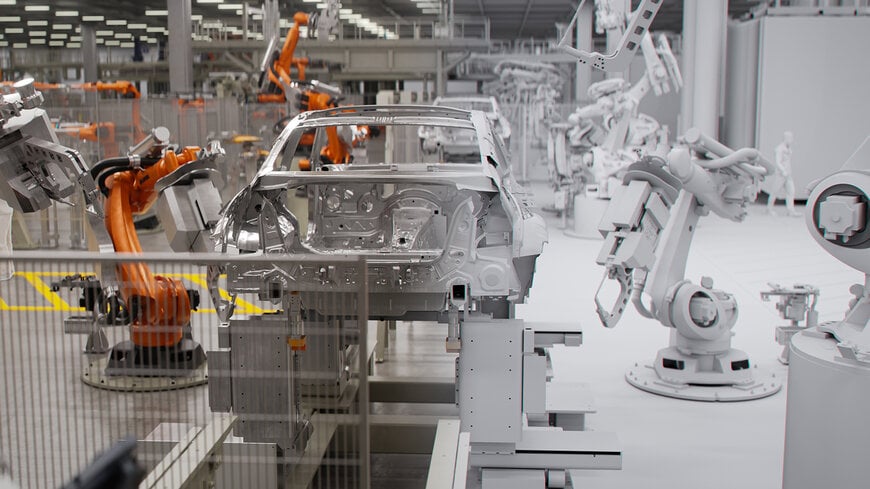
BMW has developed a Virtual Factory using NVIDIA Omniverse and OpenUSD. Image source: BMW Press
A second major application is production optimisation. PepsiCo, working with Siemens and NVIDIA technologies, has created high-fidelity digital twins of manufacturing and warehouse facilities. Siemens reported that initial deployments produced a 20% throughput increase, while identifying potential issues before physical modifications and contributing to projected capital-expenditure reductions.
The third area is robotics and autonomous systems. Virtual environments allow robots to be trained and tested before deployment. NVIDIA's Omniverse and Isaac technologies, for example, provide simulation environments in which robotic and vision-AI systems can be developed and validated.
This is particularly important as factories begin deploying increasingly autonomous machines. Training an AI model in the physical factory can be expensive, slow and potentially unsafe. Simulation provides a way to generate large quantities of synthetic training data and test unusual conditions without disrupting production.
Mixed reality brings the digital twin to the worker
If digital twins provide the virtual representation and AI provides intelligence, mixed reality provides the human interface.
AR and MR headsets can overlay digital information on physical equipment. A maintenance technician can see operating parameters, instructions, component identification or repair procedures while standing in front of a machine.
The technology can also support remote assistance. An expert located hundreds or thousands of kilometres away can see what the technician sees and guide the intervention.
Training is another important application. Operators can learn procedures in an immersive virtual environment before interacting with expensive or hazardous equipment.
The significance is that the industrial metaverse does not necessarily require workers to disappear into virtual worlds. In many industrial applications, the more useful model is the opposite: bringing relevant digital information into the worker's physical environment.
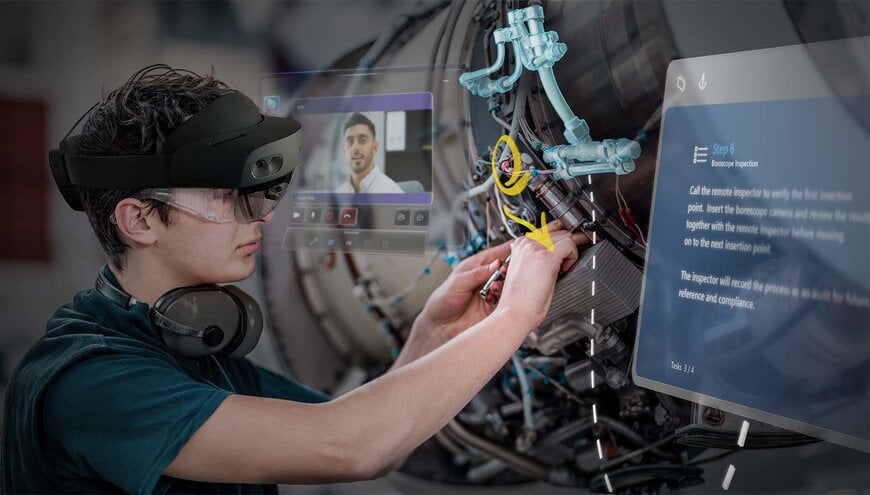
AR and MR headsets can overlay digital information on physical equipment. Image source: Microsoft
Is 5G the missing link?
Industrial metaverse applications generate demanding requirements. High-resolution 3D environments, machine data, video streams and XR applications can require high bandwidth and low latency.
5G – and increasingly 5G Advanced – can provide the connectivity required for mobile industrial applications, particularly where wired connections are impractical.
A notable Indian example is the collaboration between Ericsson, Volvo Group and Bharti Airtel to investigate XR, digital twins and AI over 5G Advanced at Volvo's factory and R&D centre in Bengaluru. The project is exploring applications including human-machine collaboration, workforce training and real-time process optimisation.
Yet 5G should not be regarded as a prerequisite for every industrial-metaverse application. Many fixed factory applications can operate effectively using industrial Ethernet, Wi-Fi or private wireless networks. The real value of 5G emerges where mobility, low latency and large-scale connectivity are important.
Indeed, the industry is already looking beyond 5G. Ericsson's 2026 VICTOR6G research project is investigating real-time virtualisation for industrial applications, including digital twins and remote robot control in industrial metaverse environments.
Who is leading the industrial metaverse?
The competitive landscape is becoming broader than the traditional metaverse companies.
- Siemens is one of the strongest industrial players because it combines automation, industrial software, digital twins, PLM, IoT and engineering expertise. Its partnership with NVIDIA adds photorealistic simulation, accelerated computing and AI capabilities.
- NVIDIA has emerged as a critical infrastructure and simulation-platform provider through Omniverse, alongside its AI computing and robotics ecosystem.
- Microsoft remains important through Azure, cloud services, industrial IoT, mixed reality and enterprise collaboration technologies.
- PTC is a major player in digital twins, IoT and augmented reality, particularly through its ThingWorx and Vuforia technologies.
- Dassault Systèmes brings its 3DEXPERIENCE platform, simulation and virtual-twin capabilities to product development and industrial engineering.
- Unity and Epic Games contribute real-time 3D technologies that can support industrial visualisation and simulation, while Ansys is important in physics-based engineering simulation.
The telecommunications layer is being developed by companies such as Ericsson, Nokia and Qualcomm, while industrial automation companies including ABB, Schneider Electric, Rockwell Automation and Honeywell are connecting physical automation systems with digital platforms.
The most important development, therefore, is not the emergence of a single ‘metaverse company’. It is the formation of ecosystems linking industrial automation, software, AI, simulation, connectivity and cloud platforms.
The reality check
Despite impressive demonstrations and real deployments, the industrial metaverse has not yet reached its ultimate vision.
The biggest challenge is data integration. As BMW has noted, creating the digital twin itself is not necessarily the hardest task; connecting existing systems and keeping the virtual and physical environments synchronised is much more difficult.
Legacy machines, proprietary protocols, incompatible databases and inconsistent asset information can all prevent organisations from creating a reliable digital thread.
There are also questions around cybersecurity, data ownership, computing requirements, interoperability and the skills needed to build and maintain sophisticated digital environments.
Another reality is that not every industrial problem requires a metaverse. A simple dashboard may be more appropriate than an immersive 3D environment. The technology must therefore demonstrate measurable benefits in productivity, quality, safety, energy efficiency, engineering time or capital expenditure.
From hype to industrial infrastructure
The industrial metaverse is consequently evolving away from its original image of virtual reality and toward something much more useful: a continuously connected simulation and decision-making layer for the physical enterprise.
Its most convincing applications are already visible in factory planning, production engineering, robotics, logistics, worker training, maintenance and remote collaboration. The convergence of digital twins, AI, IoT, XR and advanced connectivity is working – but not as one giant virtual world. Instead, the industry is building a collection of interconnected digital environments that increasingly mirror physical assets and processes.
The next major step will be to make those environments intelligent and operationally consequential. When AI agents can use real-time industrial data, reason inside physics-based digital twins, simulate alternatives and safely translate decisions back into the physical factory, the industrial metaverse will cease to be primarily a visualisation technology. It will become part of the operating architecture of the intelligent enterprise.
That is perhaps the most important distinction between the metaverse of yesterday and the industrial metaverse taking shape today: the objective is no longer to escape the physical world, but to understand, optimise and control it better.
Article contributed by Milton D’Silva, a freelance technical writer, and former editor of Industrial Products Finder, India.
The most important development, therefore, is not the emergence of a single ‘metaverse company’. It is the formation of ecosystems linking industrial automation, software, AI, simulation, connectivity and cloud platforms.
The reality check
Despite impressive demonstrations and real deployments, the industrial metaverse has not yet reached its ultimate vision.
The biggest challenge is data integration. As BMW has noted, creating the digital twin itself is not necessarily the hardest task; connecting existing systems and keeping the virtual and physical environments synchronised is much more difficult.
Legacy machines, proprietary protocols, incompatible databases and inconsistent asset information can all prevent organisations from creating a reliable digital thread.
There are also questions around cybersecurity, data ownership, computing requirements, interoperability and the skills needed to build and maintain sophisticated digital environments.
Another reality is that not every industrial problem requires a metaverse. A simple dashboard may be more appropriate than an immersive 3D environment. The technology must therefore demonstrate measurable benefits in productivity, quality, safety, energy efficiency, engineering time or capital expenditure.
From hype to industrial infrastructure
The industrial metaverse is consequently evolving away from its original image of virtual reality and toward something much more useful: a continuously connected simulation and decision-making layer for the physical enterprise.
Its most convincing applications are already visible in factory planning, production engineering, robotics, logistics, worker training, maintenance and remote collaboration. The convergence of digital twins, AI, IoT, XR and advanced connectivity is working – but not as one giant virtual world. Instead, the industry is building a collection of interconnected digital environments that increasingly mirror physical assets and processes.
The next major step will be to make those environments intelligent and operationally consequential. When AI agents can use real-time industrial data, reason inside physics-based digital twins, simulate alternatives and safely translate decisions back into the physical factory, the industrial metaverse will cease to be primarily a visualisation technology. It will become part of the operating architecture of the intelligent enterprise.
That is perhaps the most important distinction between the metaverse of yesterday and the industrial metaverse taking shape today: the objective is no longer to escape the physical world, but to understand, optimise and control it better.
Article contributed by Milton D’Silva, a freelance technical writer, and former editor of Industrial Products Finder, India.
