
www.industry-asia-pacific.com
27
'26
Written on Modified on
IICCS Forum 2026 Positions Indonesia as Regional CCS Hub
The Jakarta event highlighted international partnerships, bilateral Joint Credit Mechanism milestones, and cross-border carbon storage frameworks.
iccscenter.com
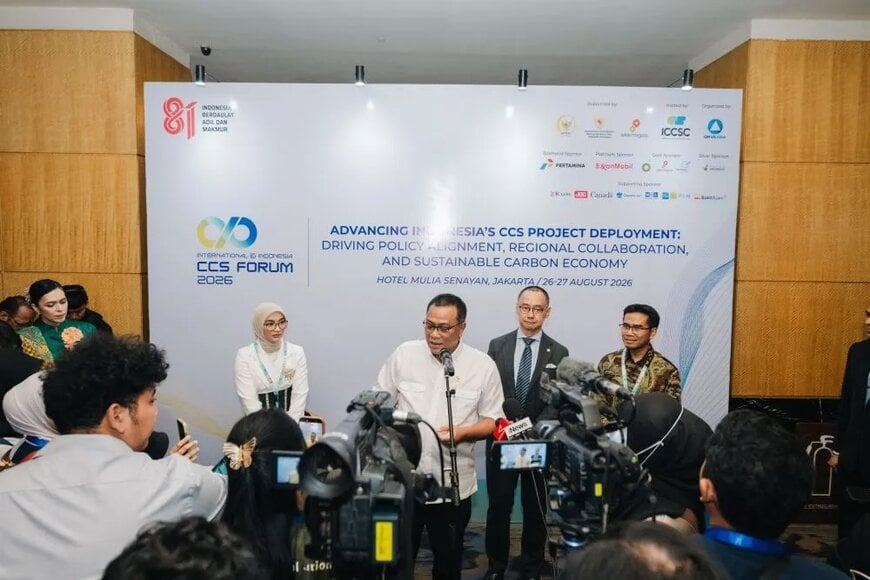
The Indonesia Carbon Capture and Storage Center (ICCSC) hosted the 4th International & Indonesia Carbon Capture and Storage (IICCS) Forum 2026 at Hotel Mulia Senayan in Jakarta. Held under the theme "Advancing Indonesia's CCS Project Deployment: Driving Policy Alignment, Regional Collaboration, and Sustainable Carbon Economy," the two-day forum gathered global regulators, investors, and technology providers. Highlighting the country's transition from policy design to commercial deployment, key forum outcomes included the signing of MoUs between ICCSC and the Indonesia Carbon Trade Association (IDCTA), as well as with Korea's ETRS Center to foster low-carbon offshore infrastructure cooperation.
On the project front, the forum celebrated a major bilateral milestone with the approval of the Ofaweri decarbonization initiative utilizing Tangguh CCUS under the Indonesia-Japan Joint Credit Mechanism (JCM)—making it the first CCUS project registered under the framework. Additionally, Pertamina Hulu Energi and ICCSC launched a collaborative book exploring cross-border carbon storage mechanisms to activate the domestic market. Key speakers, including ICCSC Executive Director Dr. Belladonna Troxylon Maulianda and MPR RI Deputy Speaker Dr. Eddy Soeparno, emphasized that aligning regulatory frameworks, international financing, and commercial execution will establish Indonesia as a premier decarbonization and CCUS destination across the Asia-Pacific region.
Additional Context
This section provides technological and market background not explicitly detailed in the original release.
Indonesia possesses one of the largest carbon storage potentials in Southeast Asia, with depleted oil and gas reservoirs and deep saline aquifers estimated to hold upwards of 400 to 600 gigatons of $CO_2$ storage capacity across basins such as South Sumatra, East Java, and Kutai. To commercialize this capacity, Indonesia enacted groundbreaking regulatory frameworks, including Presidential Regulation No. 14/2024, which formally permits operators to allocate up to 30% of domestic storage capacity for cross-border carbon imports. For heavily industrialized economies in the Asia-Pacific with limited domestic geological storage—such as Japan, South Korea, and Singapore—Indonesia represents a critical regional sequestration hub. Establishing robust bilateral frameworks like the Joint Credit Mechanism (JCM) is essential to provide legally binding carbon credit verification, cross-border liability structures, and transparent MRV (Monitoring, Reporting, and Verification) protocols necessary to mobilize private capital for multi-billion-dollar CCUS value chains.
Edited by Lekshman Ramdas, Induportals editor – adapted by AI.
www.iccscenter.com
