
www.industry-asia-pacific.com
27
'26
Written on Modified on
Arrow Presents Intelligent Power Solutions at PCIM Asia
The company showcases end-to-end 800VDC data center architectures and wide-bandgap semiconductors for AI infrastructure in Shenzhen.
www.arrow.com
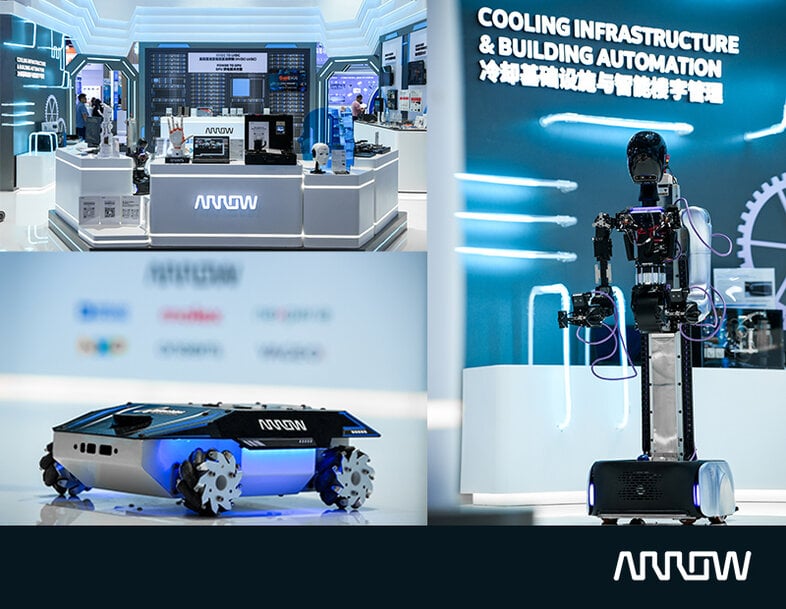
Arrow Electronics is exhibiting its latest AI, electrification, and intelligent power solutions at PCIM Asia Shenzhen 2026, held from August 26-28. Partnering with major component manufacturers including Analog Devices, Molex, Nexperia, NXP, onsemi, STMicroelectronics, and Yageo, Arrow is addressing the escalating energy and thermal management demands of modern digital infrastructure. A major centerpiece at Booth D20 is the "Next-Gen 800VDC Data Center Empowers AI Factory" showcase. This exhibit demonstrates a fully connected energy management ecosystem encompassing solar harvesting, 800VDC power distribution, high-density power conversion, liquid cooling, and AI-driven robotics.
The exhibit highlights critical power delivery stages, including solid-state transformers for medium-voltage direct step-down, HVDC to LVDC conversion, and the final 48V bus delivery directly to the GPU core. Jacky Wan, vice president of sales components, China, at Arrow Electronics, emphasized that AI and electrification are driving unprecedented requirements for efficiency, power density, and system integration. By combining wide-bandgap semiconductor technologies with expert power architecture design, Arrow aims to help customers accelerate the development of sustainable, high-performance next-generation data centers and industrial solutions.
Additional Context
This section provides technological and market background not explicitly detailed in the original release.
The explosive growth of generative AI and large-scale machine learning has dramatically increased the power consumption of server racks. Traditional data centers operating on standard AC distribution and 12V DC rack architectures struggle to deliver the massive currents required by high-end AI accelerators without incurring severe transmission losses. Shifting to an 800VDC facility-level distribution combined with a 48V rack architecture significantly reduces resistive power losses ($I^2R$ losses) by transmitting power at higher voltages and lower currents. Furthermore, to achieve the extreme power densities needed to step down these voltages near the chip, engineers are rapidly adopting wide-bandgap semiconductors like silicon carbide (SiC) and gallium nitride (GaN). These materials offer superior switching frequencies and lower thermal resistance compared to traditional silicon, enabling the miniaturization of power modules and freeing up critical board space for advanced liquid cooling infrastructure.
Edited by Lekshman Ramdas, Induportals editor – adapted by AI.
www.arrow.com
