
www.industry-asia-pacific.com
17
'26
Written on Modified on
ABB Powers Allseas’ Heavy Transport Vessel for Offshore Wind Logistics
Integrated power and Azipod propulsion enable precise maneuvering, high bollard pull and efficient transport of offshore wind converter stations.
global.abb
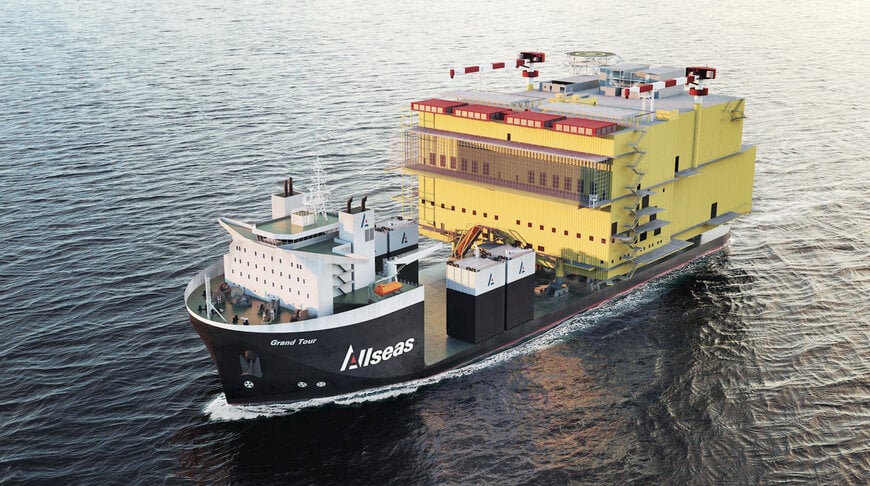
ABB has secured a supply contract with Guangzhou Shipyard International to deliver a complete power and propulsion system for the Grand Tour, a 230-meter semi-submersible heavy transport vessel. This technical delivery focuses on equipping the ship with advanced electrical thrusters and power management architecture to support marine logistics within the European offshore wind energy sector.
Dynamic Positioning and Heavy Lift Operational Mechanics
The Grand Tour vessel, ordered by offshore contractor Allseas and scheduled for delivery in 2028, functions as a critical logistical link in the offshore wind supply chain. The vessel is engineered to transport loads of up to 40,000 metric tons, specifically focusing on large converter stations sourced from fabrication facilities in Asia and Europe. These converter stations operate at the core of long-distance offshore power transmission by converting alternating current generated by wind turbines into direct current for efficient site-to-shore cable transfer.
Upon reaching the installation site, the semi-submersible design allows the Grand Tour to lower its main deck below the waterline. This mechanism enables the vessel to float the heavy converter stations directly onto the Pioneering Spirit construction vessel. Executing this transfer requires precise station-keeping and active dynamic positioning capabilities alongside the receiving ship.
Gearless Propulsion Architecture and Power Management Systems
To meet the required bollard pull and dynamic positioning specifications, the vessel utilizes four 3.5-megawatt nozzled Azipod propulsion units. These units rotate 360 degrees to facilitate exact maneuverability and positional holding at the bow of the receiving construction vessel. The inclusion of optimized nozzles ensures high hydrodynamic efficiency during long-distance transit.
The gearless architecture of the Azipod propulsion units reduces mechanical energy losses, fuel consumption, and acoustic vibration when compared to conventional mechanical thrusters. Furthermore, the elimination of gear mechanisms decreases lubrication oil requirements, which lowers routine maintenance demands and operational costs. The compact footprint of this electrical pod technology also minimizes internal space constraints during the vessel design phase.
The power infrastructure includes a medium-voltage alternating current power plant operating in a closed ring topology. This network is actively regulated by a proprietary power and energy management system and an enhanced power plant protection system. The complete powertrain integration is supplemented by remote condition monitoring capabilities to track mechanical and electrical performance metrics.
Additional Context:
This section details technical specifications and competitive benchmarking not included in the original product announcement
Electric podded propulsion systems are frequently evaluated against traditional mechanical azimuth thrusters and diesel-direct drive systems in the maritime heavy-lift sector. Benchmark criteria typically include hydrodynamic efficiency, internal space utilization, and dynamic positioning response times. Podded electrical units place the propulsion motor directly inside a submerged pod outside the ship hull, which eliminates the need for long internal shaft lines and complex mechanical gearing.
In competitive benchmarking, gearless podded systems generally demonstrate a 5 to 15 percent increase in hydrodynamic efficiency over standard mechanical L-drive or Z-drive thrusters, largely due to optimized wake fields and the removal of gear transmission losses. Alternative manufacturers, such as Kongsberg Maritime and Schottel, offer competing azimuth thruster technologies that are heavily utilized in the offshore market; however, gearless electrical pods are often selected for dynamic positioning class 2 and 3 offshore construction vessels due to their rapid 360-degree thrust vectoring response and reduced mechanical wear profiles.
Edited by Natania Lyngdoh, Induportals editor, assisted by AI.
www.abb.com
