
www.industry-asia-pacific.com
23
'26
Written on Modified on
Direct Time-of-Flight 3D LiDAR Module for Edge Systems
STMicroelectronics introduces a high-resolution 3D sensing module providing depth mapping and spatial awareness for robotics, industrial automation, and smart infrastructure.
www.st.com

STMicroelectronics has announced the VL53L9, a direct Time-of-Flight 3D LiDAR module designed to provide high-resolution sensing for low-compute edge AI systems. The hardware targets spatial data processing across robotics, industrial automation, smart buildings, virtual reality hardware, and healthcare applications.
Technical Specifications and Sensing Capabilities
The module delivers 2,268 resolution zones arranged in a 54 by 42 grid, combined with a 54-degree by 42-degree field of view. Utilizing stacked backside-illuminated single-photon avalanche diode sensor technology and metasurface optical elements, the architecture enables a sensing range from less than 5 centimeters to 9 meters with a 1 percent accuracy margin. The hardware captures spatial data at 100 frames per second, allowing systems to map 3D depth environments and detect small objects continuously.
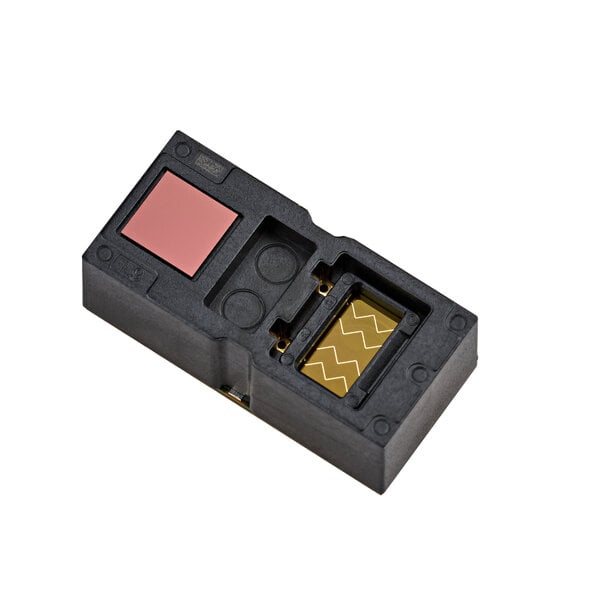
ST FlightSense L9 product
Architecture and Edge AI Integration
The sensor employs dual-scan flood illumination instead of traditional dot scanning to reduce motion artifacts, eliminate dead zones, and capture complementary 2D infrared and 3D depth images. By integrating on-chip direct Time-of-Flight processing and a dedicated power management integrated circuit, the calibration-free module simplifies the post-processing workload. This enables edge AI applications to function efficiently on microcontrollers with limited computational resources.
Application Areas and Use Cases
Continuous 3D depth data output supports specific industrial and consumer applications. In robotics, the module facilitates simultaneous localization and mapping alongside obstacle avoidance for autonomous navigation. For industrial automation, it enables accurate volumetric measurement in tanks and bins to support inventory tracking. In smart buildings, the sensor detects human presence and counts occupants without capturing identifiable optical images, preserving privacy. Additional use cases involve fall detection monitoring in healthcare settings and skeletal finger tracking for gesture recognition in virtual reality systems.
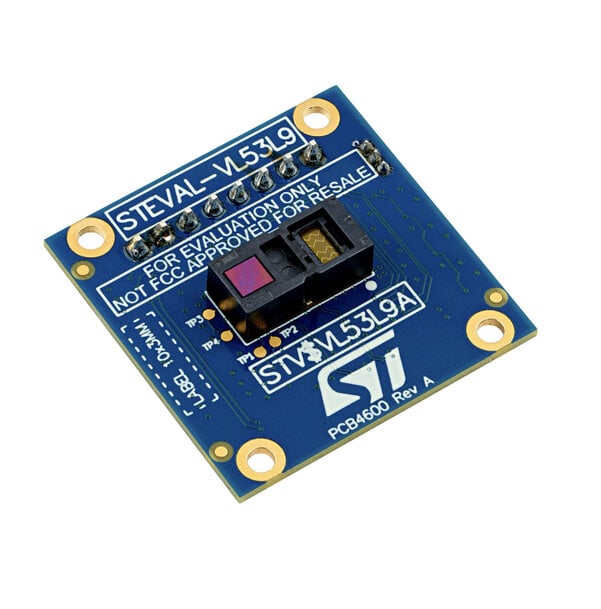
ST FlightSense L9 eval board
Hardware Design and Interface Compatibility
The components are housed within a 12.8 millimeter by 6.1 millimeter by 4.6 millimeter reflowable package compatible with multiple cover glass materials. It operates on dual power supplies of 1.2 volts and 3.3 volts, transmitting data through MIPI or I3C interfaces to maintain compatibility with diverse central processing unit architectures. The hardware holds a Class 1 laser safety certification. Alexandre Balmefrezol, Executive Vice President and General Manager of the Imaging Sub-Group at STMicroelectronics, noted that combining high-resolution depth data, high frame rates, and a fully integrated architecture in a single module simplifies integration and reduces system complexity. Volume shipments and mass production are scheduled for early July 2026.
Additional Context:
This section details technical specifications and competitive benchmarking not included in the original product announcement
The direct Time-of-Flight module market features multiple sensing architectures designed for edge AI and spatial awareness. Comparable technologies include the ams OSRAM TMF882x series, which provides multi-zone sensing but typically supports up to 64 zones, whereas the STMicroelectronics module achieves 2,268 zones. Infineon REAL3 3D image sensors utilize indirect Time-of-Flight technology, offering high resolutions for automotive and mobile applications, but generally require more complex external post-processing compared to fully integrated direct Time-of-Flight modules. By integrating a power management integrated circuit and data processing on-chip, the STMicroelectronics footprint minimizes the external component count required compared to competing discrete sensor configurations.
Edited by Natania Lyngdoh, Induportals editor, assisted by AI.
www.st.com
