
www.industry-asia-pacific.com
27
'26
Written on Modified on
Edge Artificial Intelligence Computing Architectures for Industrial Automation
ASRock Industrial presents multimodal robotics, localized large language model execution, and deterministic control solutions at COMPUTEX Taipei 2026.
www.asrockind.com
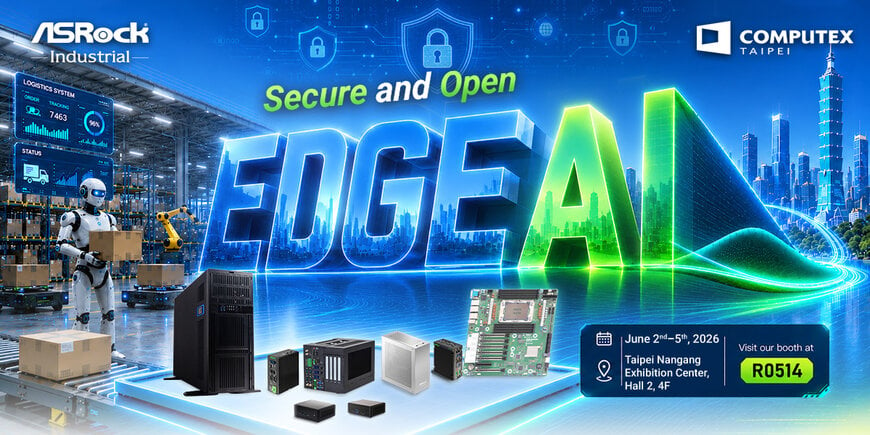
ASRock Industrial is exhibiting its latest edge artificial intelligence computing platforms and industrial computing architectures at COMPUTEX Taipei, scheduled from June 2 to June 5, 2026, at the Taipei Nangang Exhibition Center (TaiNEX2). The hardware and software integrations focus on executing multimodal workloads, localized large language models, and physical control directly at the network edge. These systems are designed to address data latency, cybersecurity constraints, and deterministic control requirements in sectors including healthcare, industrial manufacturing, and critical infrastructure.
Multimodal Robotics and Physical Artificial Intelligence
Executing physical operations without cloud dependency requires processing computer vision, voice recognition, and mechanical reasoning locally. The Agentic Robot101 architecture utilizes the NUC-358H platform to process sensor inputs and execute physical actions in real time. By keeping computation at the edge, the system reduces latency in human-machine interaction and maintains operational continuity in environments with unstable network connectivity.
Localized Healthcare Architectures and Compliance Frameworks
Data privacy regulations often restrict the use of cloud-based processing in medical and enterprise environments. To manage clinical data locally, the AI BOX-A395 workstation is integrated with the Taiwan AI Cloud AFS AI Hub. Running the Formosa Foundation Model, this system functions as a medication safety agent that analyzes drug interactions within secure hospital networks. Furthermore, the workstation operates as a compliance appliance utilizing the Institute for Information Industry (III) ASTRA Regulatory-as-Code engine. This framework automatically validates on-device large language models against the EU AI Act, OWASP LLM Top 10 vulnerabilities, and the NIST AI Risk Management Framework without exporting data to external servers.
Storage Virtualization for Large Language Models
Running multi-billion parameter language models locally is typically constrained by the physical limits of system memory and graphics processing unit resources. To expand memory capacity, the AI BOX-A395 integrates the Phison aiDAPTIV architecture. This technical approach virtualizes a purpose-built solid-state drive as a third-tier dynamic memory pool. By offloading data from primary system memory to the storage cache, the system can execute generative algorithms and multimedia applications that would otherwise exceed local hardware specifications.
Workload Security and Automated Engineering
Securing distributed computational nodes requires isolation mechanisms at the operating system level. The OpenClaw platform integrates AiSafeguard policy controls with the Exein Runtime environment, providing sandbox isolation and runtime behavior monitoring. This setup detects anomalous activities and isolates compromised workloads without interrupting the primary system functions. On the development side, the AiUAC Copilot utilizes machine learning to generate open automation applications based on the IEC 61499 standard. This assists engineers in deploying standardized function block control directly to industrial controllers.
Industrial Edge Platforms and Deterministic Controllers
To support intensive local training and real-time inference, the iEPF-11000S Series integrates Intel Xeon 600 processors and accommodates up to four graphics processing units. For harsh industrial deployments such as machine vision and factory automation, the iEPF-9500S-EW7, iEPF-9040S, and iEPF-9040VS lines provide extended thermal tolerance. For operational technology integration, controllers like the iEP-5010G-DCN provide deterministic control. This specific unit holds ATEX Zone 2 and UL C1D2 certifications, verifying its hardware for safe operation in chemical processing, oil and gas extraction, and heavy manufacturing where explosive atmospheres may occur. For general embedded applications, the NUC(S) Ultra 300 BOX Series utilizes Intel Core Ultra Series 3 processors, while updated motherboard portfolios support AMD EPYC and Ryzen platforms.
Additional Context: Technical Specifications and Competitive Benchmarking
This section details technical specifications and competitive benchmarking not included in the original product announcement.
The deployment of large language models at the network edge is highly dependent on memory scaling architectures. Utilizing a specialized solid-state drive as a dynamic memory pool, such as the Phison aiDAPTIV integration, provides an alternative to traditional multi-node clustering or high-density Video RAM configurations. While executing inference from a solid-state cache generally yields a lower token-per-second generation rate than direct execution from dedicated hardware memory, it significantly reduces the thermal design power and physical hardware footprint required to run 70-billion parameter models locally. Additionally, the inclusion of ATEX Zone 2 and UL C1D2 certifications on the iEP-5010G-DCN controllers indicates specific engineering modifications, such as sealed enclosures and spark-free circuit designs, which distinguish these units from standard commercial Internet of Things gateways and permit their installation in hazardous classified locations.
Edited by an industrial journalist, Lekshman Ramdas, with AI assistance.
www.asrockind.com
