
www.industry-asia-pacific.com
06
'26
Written on Modified on
Secure Edge AI Platform Implementation for Trustworthy Robotic Systems
ASRock Industrial demonstrates secure edge AI platforms and zero-trust architecture at CYBERSEC 2026 to enhance the cybersecurity of autonomous robotic applications.
www.asrockind.com
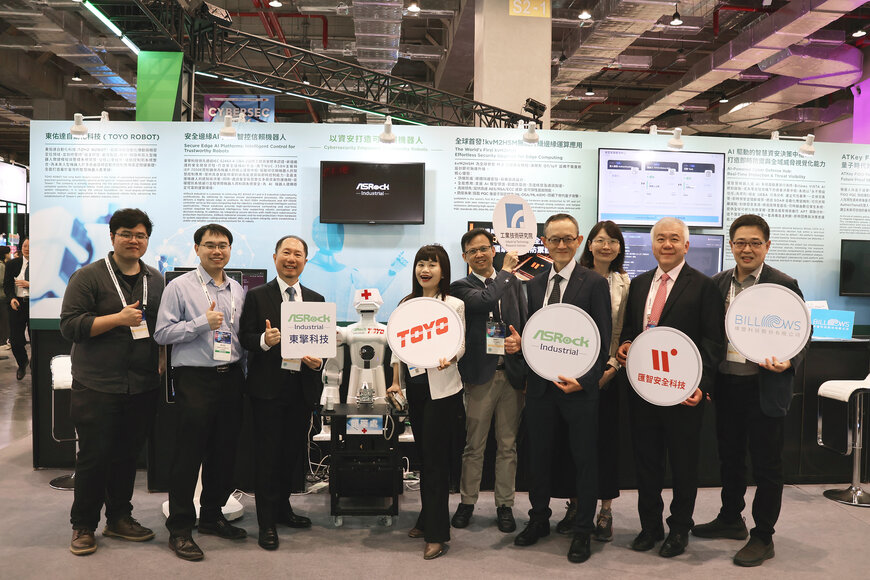
At CYBERSEC 2026, held from May 5 to 7 in Taipei, a collaborative project between ASRock Industrial, the Taiwan robotics supply chain, and ITRI addressed the integration of cybersecurity within intelligent systems. The demonstration focused on the development of a robotic platform that prioritizes embedded security from the foundational hardware level. Central to this implementation is the NUC-358H secure edge AI platform, which provides the computing base for autonomous operations in environments requiring high levels of data integrity and operational reliability.
Technical Challenges in Autonomous Care
The deployment of autonomous robots in sensitive sectors, such as elderly care, presents significant technical challenges regarding data privacy and system hijacking. Standard robotic systems often lack the necessary hardware-level security to prevent unauthorized access or behavioral anomalies during critical tasks. In a healthcare application, the requirement for precise medication delivery necessitates a system that can verify device identity and monitor operational behavior in real time to prevent errors or malicious interference.
Platform Integration and Security Standards
To address these requirements, ASRock Industrial utilized its secure edge AI platform, which adheres to IEC 62443-4-1 and IEC 62443-4-2 industrial cybersecurity certifications. The NUC-358H platform utilizes a zero-trust architecture, requiring continuous verification of device identity and behavior. The solution incorporates Post-Quantum Cryptography (PQC) chips to establish a trusted hardware identity. This architecture ensures that the system only executes commands after multi-layered identity verification via a PQC-secured key, establishing a secure environment for real-time AI computing.
Deployment of the Secure Robotic System
The system was deployed in a simulated elderly care scenario designed for automated medication delivery. During operation, the edge AI platform utilized ASRock Industrial’s AiSafeguard and Ai FDO protocols. AiSafeguard provided real-time threat detection and sandbox-based isolation to protect the operational technology environment from external threats. Simultaneously, the FIDO Device Onboard (FDO) standard was employed to facilitate secure, automated device onboarding. These mechanisms allowed the robot to perform care tasks while a secondary cybersecurity layer monitored behavior for any deviations from programmed parameters.
Operational Results and Benefits
The implementation demonstrated that embedding security protocols directly into the edge AI hardware reduces the risk of operational failure. When the monitoring system detected anomalies, it triggered immediate alerts and restricted robotic movements to maintain safety. This technical approach improved service quality and operational efficiency by reducing manual oversight requirements and minimizing the potential for medication errors. By securing the entire lifecycle from onboarding to runtime, the platform provided a stable and verifiable foundation for scaling autonomous systems in regulated industries.
Edited by an industrial journalist, Lekshman Ramdas, with AI assistance.
www.asrockind.com
