
www.industry-asia-pacific.com
20
'26
Written on Modified on
Acceed introduces rugged NRU-160-FT edge AI system
Acceed presents NRU-160-FT embedded AI computer with fanless cooling and high-performance processing for deployment in harsh industrial and outdoor environments.
acceed.com
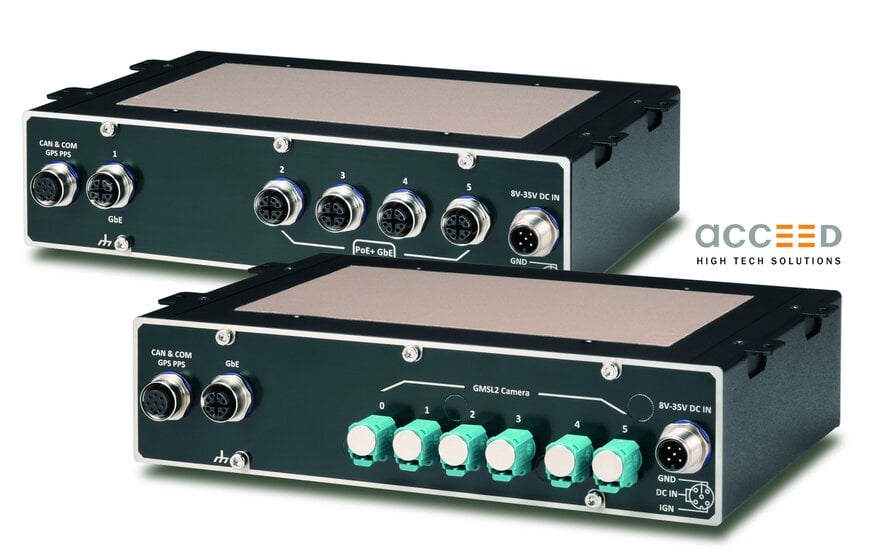
NRU-161V-FT and NRU-162S-FT from Acceed
Acceed has introduced the NRU-160-FT, a rugged edge AI computing platform designed for use in environments exposed to dust, heat, and vibration.
The system targets applications in robotics, automation, transport, and construction machinery, where data processing must occur directly at the point of operation.
High-performance AI processing
The NRU-160-FT is powered by NVIDIA Jetson Orin modules, supporting both Orin NX and Orin Nano variants. These platforms provide up to 100 INT8 TOPS of AI computing performance.
The system can process up to 18 Full HD video streams simultaneously while maintaining low power consumption of approximately 25 W. CUDA and Tensor cores enable real-time execution of neural network models directly on the device.
Fanless thermal design for reliability
A key feature of the system is its conduction cooling architecture, which dissipates heat through the enclosure rather than relying on airflow.
This design:
Acceed has introduced the NRU-160-FT, a rugged edge AI computing platform designed for use in environments exposed to dust, heat, and vibration.
The system targets applications in robotics, automation, transport, and construction machinery, where data processing must occur directly at the point of operation.
High-performance AI processing
The NRU-160-FT is powered by NVIDIA Jetson Orin modules, supporting both Orin NX and Orin Nano variants. These platforms provide up to 100 INT8 TOPS of AI computing performance.
The system can process up to 18 Full HD video streams simultaneously while maintaining low power consumption of approximately 25 W. CUDA and Tensor cores enable real-time execution of neural network models directly on the device.
Fanless thermal design for reliability
A key feature of the system is its conduction cooling architecture, which dissipates heat through the enclosure rather than relying on airflow.
This design:
- Eliminates the need for fans and filters
- Reduces maintenance requirements
- Ensures stable operation in enclosed or sealed environments
The system operates within a temperature range of –25°C to +70°C without performance throttling in standard operating mode.
Industrial connectivity and sensor integration
The NRU-160-FT is designed for integration with cameras and sensors in mobile and industrial applications.
Available configurations include:
Industrial connectivity and sensor integration
The NRU-160-FT is designed for integration with cameras and sensors in mobile and industrial applications.
Available configurations include:
- Support for up to six GMSL2 cameras for automotive and vision systems
- Multiple Gigabit Ethernet ports, including PoE support for IP cameras
- M12 connectors for robust industrial connectivity
Pre-installed drivers support widely used image sensors, enabling rapid deployment in applications such as driver assistance systems, safety monitoring, and robotic navigation.
Power management and mobility
The system supports a wide input voltage range of 8 to 35 V, making it suitable for vehicle-based applications. Power-on control allows automatic startup and shutdown with vehicle ignition, ensuring seamless integration into mobile platforms.
Additional interfaces include CAN-FD, RS-232, mini-PCIe, and M.2 expansion for communication modules, including 5G connectivity.
Compact design and deployment flexibility
With dimensions of 199 × 136 × 49 mm, the compact controller can be installed in space-constrained environments. Its design allows mounting within sealed enclosures, using external surfaces for heat dissipation.
This supports deployment in:
Power management and mobility
The system supports a wide input voltage range of 8 to 35 V, making it suitable for vehicle-based applications. Power-on control allows automatic startup and shutdown with vehicle ignition, ensuring seamless integration into mobile platforms.
Additional interfaces include CAN-FD, RS-232, mini-PCIe, and M.2 expansion for communication modules, including 5G connectivity.
Compact design and deployment flexibility
With dimensions of 199 × 136 × 49 mm, the compact controller can be installed in space-constrained environments. Its design allows mounting within sealed enclosures, using external surfaces for heat dissipation.
This supports deployment in:
- Construction and agricultural machinery
- Autonomous vehicles and logistics systems
- Roadside and infrastructure monitoring applications
Operational efficiency and cost benefits
The fanless design and low power consumption contribute to reduced energy usage and longer system lifespan. This results in lower operational costs, particularly in fleet deployments and off-grid systems.
Industry relevance
The NRU-160-FT reflects a growing trend toward edge AI systems capable of operating reliably in harsh conditions. By enabling real-time data processing at the source, such systems reduce latency and improve responsiveness in industrial and mobile applications.
Outlook for edge AI
As demand for real-time analytics and autonomous systems increases, robust edge computing platforms will play a critical role in bridging the gap between laboratory development and field deployment.
Edited by an industrial journalist, Lekshman Ramdas, with AI assistance.
www.acceed.com
The fanless design and low power consumption contribute to reduced energy usage and longer system lifespan. This results in lower operational costs, particularly in fleet deployments and off-grid systems.
Industry relevance
The NRU-160-FT reflects a growing trend toward edge AI systems capable of operating reliably in harsh conditions. By enabling real-time data processing at the source, such systems reduce latency and improve responsiveness in industrial and mobile applications.
Outlook for edge AI
As demand for real-time analytics and autonomous systems increases, robust edge computing platforms will play a critical role in bridging the gap between laboratory development and field deployment.
Edited by an industrial journalist, Lekshman Ramdas, with AI assistance.
www.acceed.com
