
www.industry-asia-pacific.com
26
'26
Written on Modified on
Panasonic Industry Introduces High-Precision Thick-Film Resistors
ERJPC series delivers 0.1% tolerance and 25 ppm/K TCR with higher power density, enabling compact and cost-efficient designs for automotive and industrial electronics.
www.panasonic.com
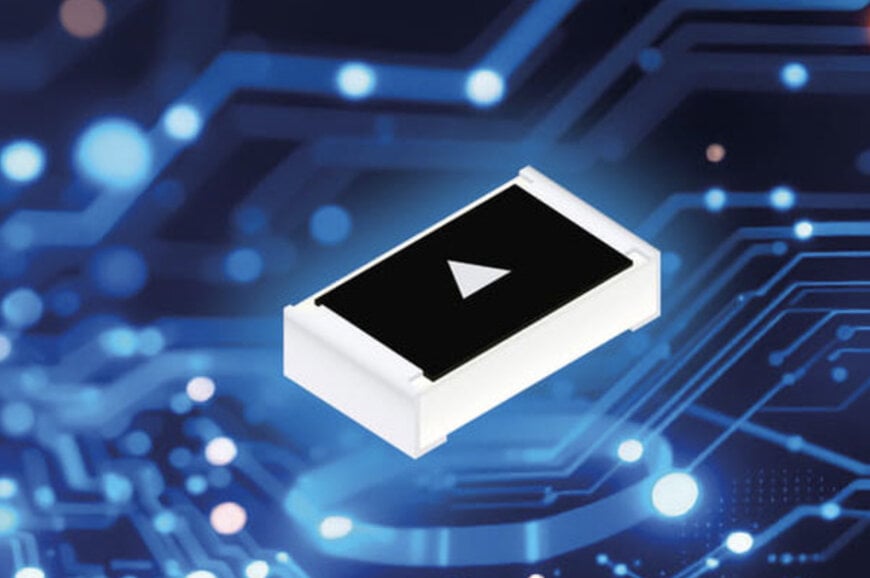
Automotive electronics, battery management systems (BMS), and industrial automation increasingly require compact, high-precision passive components that balance accuracy, stability, and cost. Panasonic Industry has introduced the ERJPC series of thick-film resistors, designed to achieve thin-film-level precision while offering higher power density and reduced footprint.
The new series targets applications such as electronic control units (ECUs), home appliances, and factory automation systems, where stable resistance values and thermal performance are critical.
Achieving thin-film-level precision with thick-film technology
The ERJPC series provides resistance tolerances down to ±0.1% and a temperature coefficient of resistance (TCR) as low as 25 ppm/K. These values approach the performance typically associated with thin-film resistors, which are often selected for high-precision applications.
By improving material composition and internal structure, the new resistors address a traditional limitation of thick-film technology—higher variability and drift—while maintaining its cost advantages.
Increased power density and reduced PCB footprint
A key differentiator of the ERJPC series is its higher power density. The resistors offer power ratings of up to 0.2 W in 0603 case size and 0.25 W in 0805 packages, which is approximately double that of comparable thin-film devices.
This allows designers to use smaller components without compromising power handling, potentially reducing PCB footprint by up to 50%. For compact electronic systems, such as automotive control modules or embedded industrial devices, this contributes to higher component density and optimized board layouts.
Stability and suitability for automotive applications
Long-term stability is addressed through the combination of low TCR and tight tolerance, improving overall resistance accuracy over time and temperature variations. This is particularly important in applications such as BMS and ECUs, where measurement accuracy directly affects system performance and safety.
The ERJPC series is compliant with AEC-Q200 standards, enabling use in automotive environments that require resistance to thermal cycling, vibration, and humidity. The devices are also manufactured using lead-free materials and comply with RoHS requirements.
Positioning within precision resistor technologies
Precision resistors are widely used in sensing, control, and power management circuits. Comparable solutions are available from manufacturers such as Vishay Intertechnology and Yageo Corporation, which offer both thin-film and high-performance thick-film resistor technologies.
Key selection criteria in this segment include tolerance, TCR, power rating, size, and long-term stability. The ERJPC series positions itself by combining thin-film-level precision with the inherent cost advantages and robustness of thick-film construction.
By enabling higher power handling in smaller packages while maintaining precision, the new resistors provide an alternative design approach for engineers seeking to optimize both performance and cost in compact electronic systems.
Edited by Natania Lyngdoh, Induportals Editor — Adapted by AI.
www.industry.panasonic.com
