
www.industry-asia-pacific.com
04
'26
Written on Modified on
Dassault Systèmes, NVIDIA Build Industrial AI Platform for Virtual Twins
Together, the companies are establishing a shared industrial AI architecture that combines science-validated Virtual Twins with accelerated AI infrastructure for scalable deployment across industries.
www.3ds.com
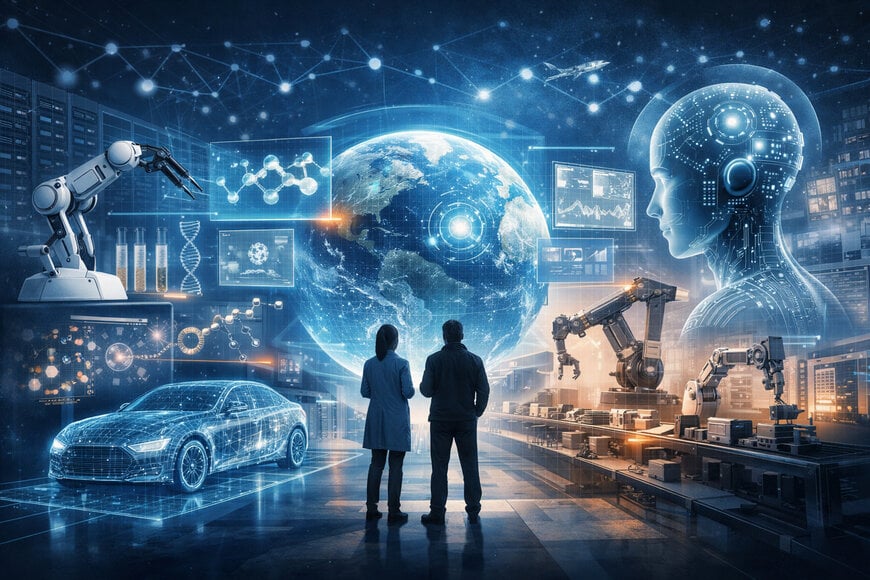
Engineering, manufacturing, life sciences, and industrial research are increasingly adopting artificial intelligence to manage system complexity, improve simulation accuracy, and accelerate innovation. Dassault Systèmes and NVIDIA have announced a long-term strategic partnership to develop a shared industrial AI platform designed to support mission-critical use cases at scale.
The collaboration combines Dassault Systèmes’ Virtual Twin technologies with NVIDIA’s AI infrastructure, open models, and accelerated computing libraries. The result is an industrial AI architecture built around science-validated “industry world models,” intended to serve as a trusted system of record rather than a standalone or experimental AI solution.
From digital models to science-validated world models
At the core of the partnership is the integration of Virtual Twins with AI systems grounded in physics, engineering principles, and validated industrial data. By embedding AI within these models, the platform aims to support predictive simulation, operational optimization, and decision-making across complex systems in biology, materials science, engineering, and manufacturing.
The approach introduces a new operational concept described as “skilled virtual companions.” These AI-based assistants operate within the agentic 3DEXPERIENCE platform, drawing on deep industrial context to augment human expertise rather than replacing it.
AI infrastructure and sovereign deployment
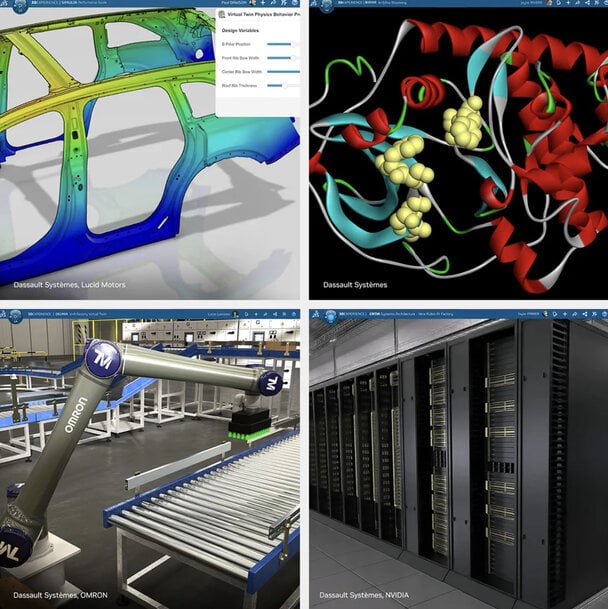
As part of its cloud strategy, Dassault Systèmes—through its OUTSCALE brand—is deploying AI factories designed to operate on NVIDIA’s latest AI infrastructure across three continents. These AI factories are intended to support the execution of AI models directly within the 3DEXPERIENCE platform while ensuring data privacy, intellectual property protection, and digital sovereignty for customers.
In parallel, NVIDIA is adopting Dassault Systèmes’ model-based systems engineering (MBSE) methodologies to design its own AI factories, starting with the NVIDIA Rubin platform. This work is integrated into the NVIDIA Omniverse DSX Blueprint, which targets large-scale AI factory deployment.
Application domains enabled by the platform
The shared platform is positioned to support multiple industrial domains:
- Biology and materials science: Integration of the NVIDIA BioNeMo platform with BIOVIA world models is intended to accelerate molecular discovery and materials development.
- Design and engineering: SIMULIA AI-based Virtual Twin Physics Behavior, supported by NVIDIA CUDA-X and AI physics libraries, enables faster and more accurate prediction of system behavior.
- Manufacturing systems: DELMIA Virtual Twins combined with NVIDIA Omniverse physical AI libraries support software-defined and autonomous production environments.
- Human–AI collaboration: Virtual Companions within the 3DEXPERIENCE platform combine NVIDIA Nemotron open models with industry-specific context to deliver actionable, traceable insights.
Industry adoption and validation
The partnership builds on existing collaborations with industrial and research organizations across sectors including food production, industrial automation, automotive engineering, and aerospace research. These use cases emphasize scalable simulation, validated design workflows, and reduced time from concept to deployment.
The announcement was made at 3DEXPERIENCE World, where the two companies outlined their shared vision for industrial AI as a foundational, science-based capability supporting long-term value creation.
www.3ds.com
The partnership builds on existing collaborations with industrial and research organizations across sectors including food production, industrial automation, automotive engineering, and aerospace research. These use cases emphasize scalable simulation, validated design workflows, and reduced time from concept to deployment.
The announcement was made at 3DEXPERIENCE World, where the two companies outlined their shared vision for industrial AI as a foundational, science-based capability supporting long-term value creation.
www.3ds.com
