
www.industry-asia-pacific.com
30
'26
Written on Modified on
SUEZ wins Hong Kong cavern sludge treatment contract
Compact, automated Dehydris Twist dewatering will equip the Sha Tin Cavern Sewage Treatment Works, setting a benchmark for underground wastewater infrastructure in Asia.
www.suez.com
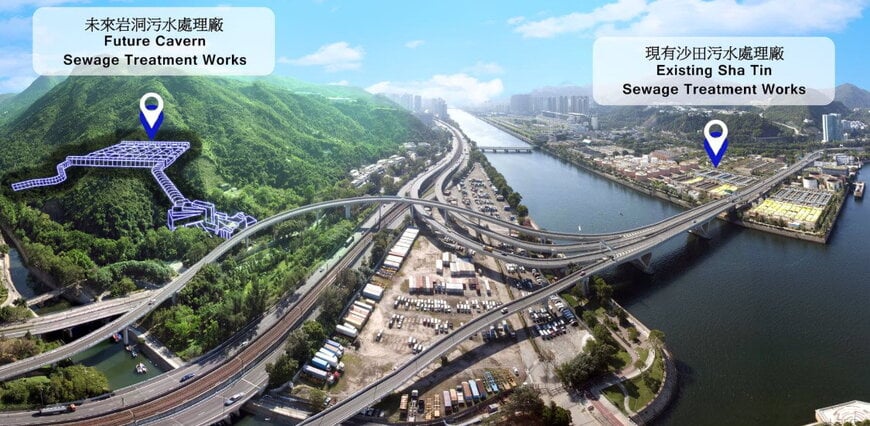
SUEZ has secured a contract from the Hong Kong Special Administrative Region’s Drainage Services Department (DSD) to provide a sludge dewatering solution for the relocation of the Sha Tin Sewage Treatment Works into purpose-built caverns. This contract encompasses design, equipment supply and delivery for the new Sha Tin Cavern Sewage Treatment Works, scheduled for completion in 2030, and reflects a focus on adapting dewatering technology to confined, underground environments.
Project Context: Relocating Sha Tin Sewage Treatment Underground
The existing Sha Tin facility, in operation for more than four decades and serving around 700,000 residents, is being modernised to address ageing infrastructure and acute land scarcity in Hong Kong. The relocation places the treatment works within a series of engineered caverns that optimise scarce urban land, reducing the surface footprint and freeing about 28 hectares of land for alternative uses. The cavern location also mitigates odour nuisance by acting as a natural barrier and enables installation of dedicated de-odourisation systems.
Technical Solution: Dehydris™ Twist Dewatering in Confined Spaces
SUEZ’s delivery for this project centres on its proven Dehydris™ Twist sludge dewatering system, a technology developed and refined over 15 years in collaboration with Bucher Unipektin AG. This system is fully enclosed, highly automated, and designed for operation in confined environments with controlled access and strict safety requirements — conditions inherent to cavern-based facilities.
The compact design of the Dehydris™ Twist system reduces the footprint by approximately 25%, allowing more efficient allocation of space for other essential equipment within the caverns. Automation reduces operator exposure and supports safer operations in restricted access areas. Previously deployed in France, Italy, Australia and mainland China, the technology has established a track record of stability and reliability across diverse operational conditions.
Tailoring to Local Conditions: Salinity and Performance Validation
Hong Kong’s sewage characteristics are influenced by seawater flushing, which affects salinity levels — typically around 5,000 – 6,000 mg/L — a factor that can impact dewatering performance. SUEZ conducted multi-year pilot testing of the Dehydris™ Twist system under local conditions, demonstrating a consistent ability to raise sludge solids content from around 3 % to at least 30 %. This performance reduces sludge volume, transport and disposal costs, and supports downstream processing for energy recovery. The system is expected to produce approximately 120,000 tonnes of dewatered sludge annually, contributing to local circularity and carbon reduction objectives.
Differentiation Compared with Conventional Solutions
Conventional sludge dewatering technologies are often designed for open, ground-level facilities with ample space and different safety and access profiles. In contrast, the solution deployed for the Sha Tin caverns addresses three specific constraints:
- Spatial limitations: The compact footprint and modular dewatering units permit deployment in narrow, underground spaces without compromising throughput or efficiency.
- Safety and automation: Fully enclosed systems with high automation levels reduce manual handling and exposure risks, crucial for subterranean operations.
- Adaptation to high salinity: Pilot validation under high-salinity sewage conditions assures performance consistency in environments where standard dewatering processes may falter due to salt interference.
These differentiators position the Dehydris™ Twist system as a specialised choice for projects where land use constraints, safety requirements and influent characteristics require tailored engineering approaches beyond typical surface-level installations.
Strategic and Environmental Implications
By enabling underground wastewater treatment with an advanced dewatering platform, the project tackles both urban planning imperatives and environmental goals. The freed surface land supports other urban uses, while improved dewatering efficiency and subsequent energy recovery align with broader sustainability objectives. The project’s integration within Hong Kong’s wastewater infrastructure also builds on SUEZ’s long-standing engagement in the region’s water and sanitation sector.
www.suez.com
Strategic and Environmental Implications
By enabling underground wastewater treatment with an advanced dewatering platform, the project tackles both urban planning imperatives and environmental goals. The freed surface land supports other urban uses, while improved dewatering efficiency and subsequent energy recovery align with broader sustainability objectives. The project’s integration within Hong Kong’s wastewater infrastructure also builds on SUEZ’s long-standing engagement in the region’s water and sanitation sector.
www.suez.com
