
www.industry-asia-pacific.com
23
'26
Written on Modified on
Mitsubishi Heavy Industries delivers mobile boarding bridge in Japan
Self-propelled seaport boarding bridge uses GNSS-guided automated driving and flexible docking to support large cruise ship operations at Yokohama’s Osanbashi terminal.
www.mhi.com
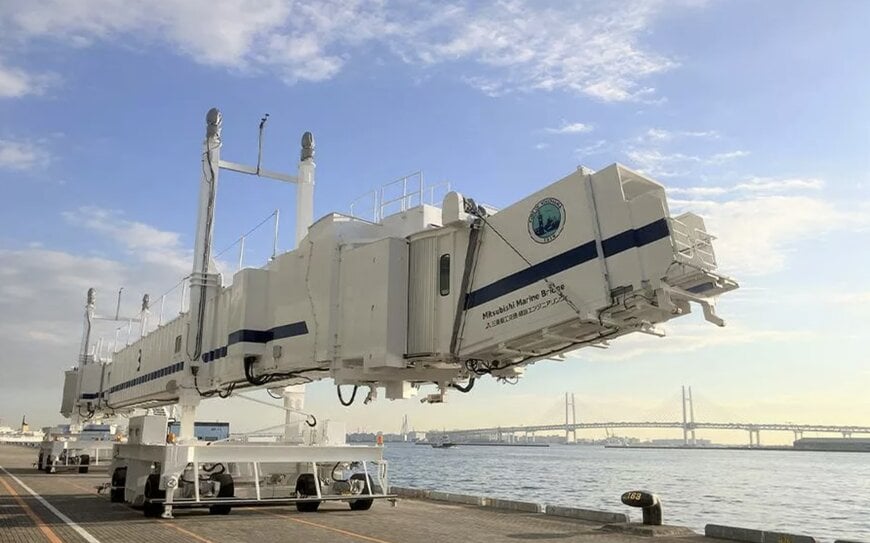
As cruise terminals handle larger vessels and tighter turnaround windows, boarding infrastructure is increasingly expected to improve passenger flow without restricting wharf operations. In this context, Mitsubishi Heavy Industries Transportation and Construction Engineering delivered a self-propelled mobile seaport passenger boarding bridge to Yokohama City for use at Osanbashi Yokohama International Passenger Terminal.
Entering service at Osanbashi terminal
The system—called the Mitsubishi Marine Bridge (MMB)—was manufactured at Mitsubishi Heavy Industries’ Mihara Machinery Works in Hiroshima Prefecture and entered service on January 13 at Osanbashi Yokohama International Passenger Terminal.
Unlike fixed boarding bridges, the self-propelled configuration is intended to connect to large luxury cruise ships docking at Osanbashi while accommodating variation in ship-side passenger access door positions.
Mobility architecture: 16-wheel independent steering
The mobile bridge uses 16-wheel independent steering control, implemented as eight-wheeled, independently controlled steering units at both the front and rear. This steering configuration allows the structure to turn at the end of the pier, enabling operation across different areas of the wharf, including potential use on both the Shinko and Yamashita sides.
Because the bridge operates without rails, the terminal avoids committing wharf space to permanent track infrastructure. This trackless setup is designed to keep the apron usable for cargo handling and movement of terminal-related vehicles—an operational consideration for mixed-use waterfront zones.
GNSS-enabled automated movement on the wharf
For positioning and movement, the bridge includes a GNSS (Global Navigation Satellite System) automated driving function. The automated driving capability was developed by applying technology originally used in the company’s fully automated docking system for airport passenger boarding bridges (PBBs).
In practice, this makes the unit capable of moving freely on the wharf under automated control rather than requiring manual towing or dedicated guiding infrastructure—supporting more dynamic berth-side operations.
Flexible docking for variable ship interfaces
The docking system is designed to handle variability on both ends of the connection:
- Terminal side: adaptable to different docking positions
- Ship side: compatible with different passenger access door positions across vessels
This is particularly relevant at cruise terminals, where ship dimensions and door geometries can differ significantly between operators and itineraries. The intent is to reduce the need for bespoke bridge placement or terminal-side modifications for each arrival, supporting smoother passenger handling across diverse vessel calls.
Power mode switching between movement and service
Power is supplied through onboard generation during movement. Generators are mounted in both the front and rear driving units, removing the need for an external power source while repositioning.
When the unit is deployed as an in-use boarding bridge, it can switch to a land-based power supply. This mode switch allows the bridge to avoid generator use during extended stationary operations.
Operational standby positioning to reduce apron obstruction
When not required for boarding, the bridge can be moved into a standby position so it does not obstruct terminal operations. This move/standby function aligns with the broader goal of maintaining open wharf space—especially useful during simultaneous servicing activities or vehicle circulation peaks.
Passenger flow and accessibility design
Consistent with passenger boarding bridge design principles, the unit includes a gently sloping ramp to support passenger movement between terminal and ship. The bridge is intended to keep passengers out of exposed wharf conditions—reducing weather impact and limiting the need for passengers to descend to apron level.
Where this fits in cruise-terminal operations
By combining trackless mobility, GNSS-assisted automated movement, and flexible docking, the mobile bridge is positioned as an infrastructure tool for cruise terminals aiming to improve passenger throughput while keeping berth-side logistics fluid—an approach aligned with the wider shift toward more responsive port-side operations in the digital supply chain.
www.mhi.com
Power mode switching between movement and service
Power is supplied through onboard generation during movement. Generators are mounted in both the front and rear driving units, removing the need for an external power source while repositioning.
When the unit is deployed as an in-use boarding bridge, it can switch to a land-based power supply. This mode switch allows the bridge to avoid generator use during extended stationary operations.
Operational standby positioning to reduce apron obstruction
When not required for boarding, the bridge can be moved into a standby position so it does not obstruct terminal operations. This move/standby function aligns with the broader goal of maintaining open wharf space—especially useful during simultaneous servicing activities or vehicle circulation peaks.
Passenger flow and accessibility design
Consistent with passenger boarding bridge design principles, the unit includes a gently sloping ramp to support passenger movement between terminal and ship. The bridge is intended to keep passengers out of exposed wharf conditions—reducing weather impact and limiting the need for passengers to descend to apron level.
Where this fits in cruise-terminal operations
By combining trackless mobility, GNSS-assisted automated movement, and flexible docking, the mobile bridge is positioned as an infrastructure tool for cruise terminals aiming to improve passenger throughput while keeping berth-side logistics fluid—an approach aligned with the wider shift toward more responsive port-side operations in the digital supply chain.
www.mhi.com
